Industry
Luxury marketing in China
Chinese luxury buyers are stepping back from the logo and paying for what they know. The brands that grow in China now teach before they sell.
Chinese luxury buyers are stepping back from the logo and paying for what they know. The brands that grow in China now teach before they sell.
A foreign brand usually comes to a luxury marketing agency in China with one of two questions. It hasn’t launched yet and wants to know where the buyers are. Or it has run accounts for years, and the content that once sold the dream now gets polite silence.
Both questions have the same answer. The buyer reads first. She searches for the exact model on Xiaohongshu (小红书), compares notes from owners and checks the price. More often than before, she then buys at home.
In 2025, 65% of Chinese luxury spending happened in mainland China and 35% abroad, as more spending came home. Source: Beijing News (新京报), reporting Bain & Company’s 2025 China luxury report, January 2026. https://m.bjnews.com.cn/detail/1769696817169746.html
| What sold luxury before | What sells it now |
|---|---|
| The logo | The craft, the material and the history behind it |
| A daigou (代购) buying abroad | An official store at home, after weeks of reading |
| A celebrity post | Detailed reviews, expert creators, long searches |
| A boutique visit that ended at the till | A boutique visit that starts a WeChat (微信) relationship |
Every source on this page was checked twice in October 2026. We review the page each quarter, because Bain revises its China figures several times a year.
What changed: from aspiration to connoisseurship
Mainland China is still as big as the Middle East, Latin America, Southeast Asia, India and Africa put together. But it stopped being the market that grew no matter what.
The global personal luxury goods market was worth €358B in 2025. The Middle East, Latin America, Southeast Asia, India and Africa combined reached around €45 billion, matching mainland China in scale. Source: Bain & Company and Altagamma, November 2025. https://www.bain.com/about/media-center/press-releases/20252/global-luxury-stays-resilient-despite-economic-headwinds-and-shifting-consumer-trends-that-reshape-marketbain--company-and-altagamma/
The mainland China personal luxury market shrank 3% to 5% in 2025. High-value clients remained its core, while younger buyers entered the market more cautiously and later. Source: Beijing News (新京报), reporting Bain & Company, January 2026. https://m.bjnews.com.cn/detail/1769696817169746.html
The buyers didn’t leave. What changed is what they’re willing to pay for.
China’s online luxury sales jumped 25% to 35% in the first quarter of 2026, with consumers stepping back from status purchases in favor of belonging and self-expression. Source: Bain & Company and Altagamma, June 2026. https://www.bain.com/about/media-center/press-releases/2026/global-luxury-stabilizes-amid-compounding-disruptions-as-brands-race-to-amplify-meaning-and-rebuild-relevance/
For a foreign brand with a real story, this helps. A status buyer wants to be seen with the bag. A knowledgeable buyer wants to know why the bag costs what it costs, and content can answer that.
Some categories fell much harder than others. The last column below is our planning view, not Bain’s.
| Category | 2025 change, mainland China | Content we would start with |
|---|---|---|
| Beauty and personal care | Up 4% to 7% | Ingredients, scent notes, the daily ritual |
| Jewelry | Down 0% to 5% | Stones, metals, provenance, value over time |
| Apparel | Down 5% to 8% | Fabric, fit, how a piece wears across seasons |
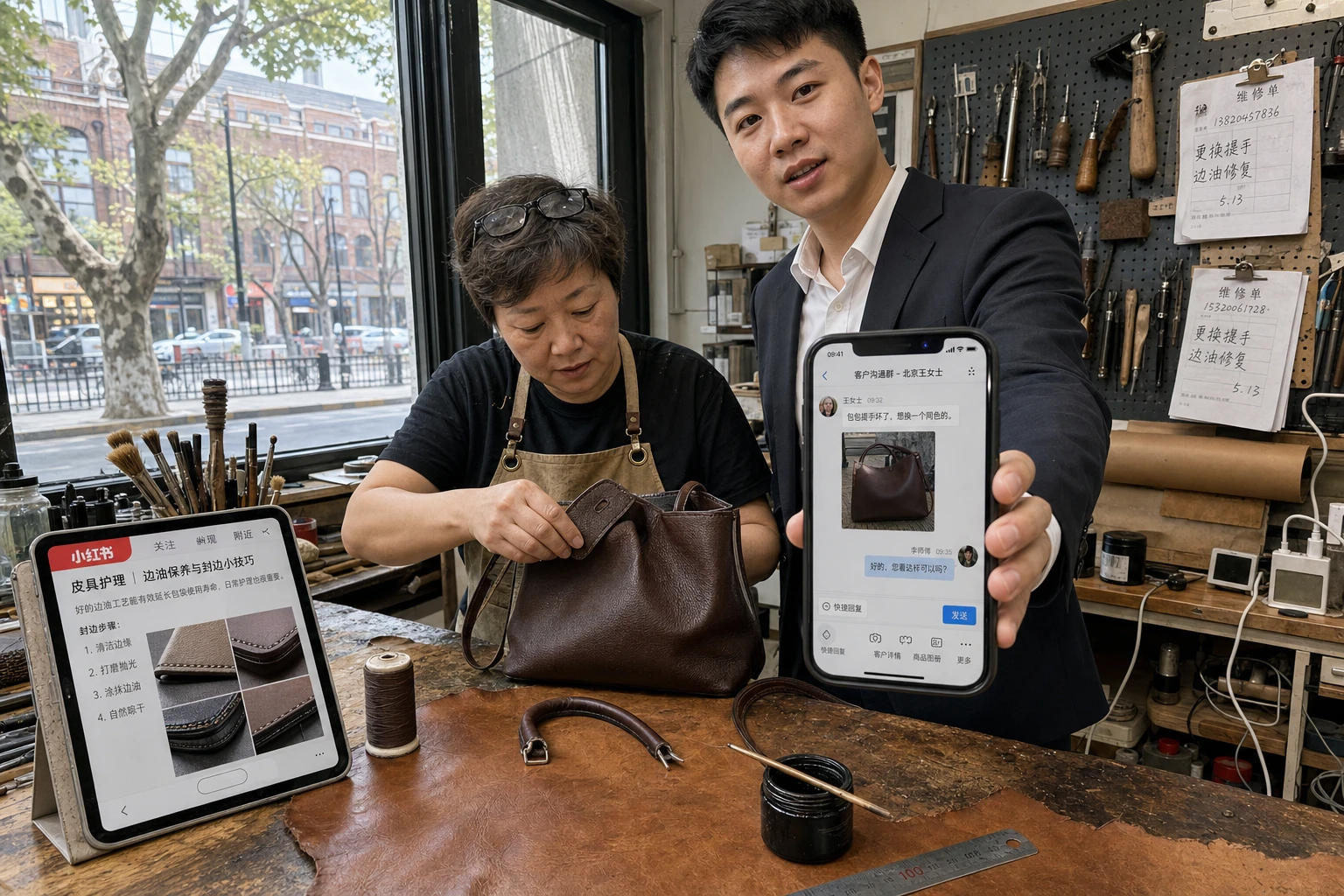
| Leather goods | Down 8% to 11% | The workshop, the hide, stitching, repair and care |
| Watches | Down 14% to 17% | Movements, heritage, servicing |
Beauty and personal care grew 4% to 7% in 2025. Apparel fell 5% to 8%, leather goods 8% to 11%, watches 14% to 17% and jewelry 0% to 5%. Source: Beijing News (新京报), reporting Bain & Company, January 2026. https://m.bjnews.com.cn/detail/1769696817169746.html
The daigou legacy, and why provenance content matters
For years, many Chinese buyers got their luxury through a daigou (代购), a personal shopper who bought abroad and resold at home. The price gap made it worth the trouble. It also taught buyers to ask one question before any other: is it real?
The law caught up with the trade in 2019.
China’s E-Commerce Law covers sellers who use “other network services”, not only online stores, and requires e-commerce operators to register as market entities. It took effect on January 1, 2019. Source: Cyberspace Administration of China (中央网信办), E-Commerce Law full text, August 2018. https://www.cac.gov.cn/2018-09/01/c_1123362506.htm
The gray market shrank, but it’s still there.
The top 45 brands on daigou platforms tracked by Re-Hub showed a slight increase in sales of 3% in 2025, as brands ramped up anti-daigou measures such as narrower price gaps and ID-based controls. Source: Bain & Company, January 2026. https://www.bain.com/insights/the-2025-chinese-personal-luxury-goods-market/
What the daigou years left behind is doubt, and that doubt is your best content brief. Provenance content answers it before it is asked. Where does the leather come from, and who cuts it? Then the dull questions that matter most to a buyer burned once by a fake: how to read a serial number, and what the official repair service covers. Each answer becomes a note or a short video in Chinese.
iGuzzini, the architectural lighting maker whose China social content we ran, started from a similar gap: “Architects knew iGuzzini. Consumers didn’t.” The work explained rather than displayed, with WeChat (微信) as “home base” and lighting shown in hotels, galleries and private homes.
“Over 24 months, iGuzzini went from a name known only in trade circles to a brand Chinese luxury consumers actually recognized.” Source: TheRedScroll, iGuzzini case study, October 2026. https://www.theredscroll.com/work/iguzzini/
Where luxury buyers research now
They search, and they take their time about it. On Xiaohongshu (小红书), the search terms get longer and more precise as the buyer gets closer.
Chinese luxury users know their needs better, and their search terms are getting more specific. More than 30 luxury brands run official stores on Xiaohongshu, and a luxury buyer’s path from first read to purchase can run past 90 days. Source: Xiaohongshu data, reported by Luxe.co (华丽志), June 2026. https://luxe.co/post/468870
Ninety days is a long time to stay in front of someone, and a plan built around launch week has usually lost the buyer by week three.
More of the purchase happens online too, and Tmall (天猫) is where many houses run their official flagship stores.
Tmall Luxury hosts more than 200 official luxury brands. Its visits rose 65% year on year in the first half of 2026, according to the head of Tmall Luxury. Source: 21st Century Business Herald (21世纪经济报道), September 2026. https://m.21jingji.com/article/20260924/herald/06e0571af0103a83e47ce2cd0fef31ea.html
So the path runs from a search on Xiaohongshu, through weeks of reading, to an official store and then, if the brand does its job, to a sales associate on WeChat (微信).
Xiaohongshu for luxury: the review problem
Xiaohongshu (小红书) is where many Chinese buyers go to read what real owners think. That makes it useful for a brand, and also hard to control.
A luxury search can surface real owners, paid creators and sellers who should not be there at all: resellers and gray-market shops that move the conversation into private messages. The platform pushes back hard.
In one month, Xiaohongshu dealt with 1.799 million violating accounts, including 714,000 “underground merchants” that hid their seller status and steered deals through private messages and comments. Source: Xiaohongshu governance notice, reported by Jiupai News (九派新闻), August 2026. https://news.qq.com/rain/a/20260826A0BHJG00
Xiaohongshu’s Community Norms list daigou (代购), resale and group buying as restricted selling, and do not encourage notes that follow merchant guidance too closely. Source: Xiaohongshu (小红书), Community Norms, updated December 2021. https://agree.xiaohongshu.com/h5/terms/ZXXY20221213003/-1
For a luxury brand, that sets three rules.
Run an official account, so a buyer can tell your voice from a reseller’s. Then give creators knowledge to work with. A script copied from the brand deck reads as an ad, and the platform’s own rules say it doesn’t want those. Finally, answer the authenticity question in your own notes: how to read a receipt, where official repairs happen, what the warranty card looks like.
How we run official accounts there is on our RedNote Agency page.
WeChat for clienteling: the client book moves into the phone
In Paris, a sales associate keeps a client book. In China, the client book lives in WeChat (微信), through WeCom (企业微信), the company version of the app. The associate adds the buyer at the counter, and from then on the new arrivals, the private viewings and the update on a watch sent away for servicing all arrive one to one, in the chat the buyer uses for everything else. Every brand fears the associate who leaves and takes that book along.
WeCom was built to stop that.
A company can move an active employee’s customers and customer groups to a colleague, and can reassign the customers of an employee who has left. Source: WeCom (企业微信) help center, September 2026, and developer center, December 2023. https://open.work.weixin.qq.com/help2/pc/14704 and https://developer.work.weixin.qq.com/document/path/92124
So the client book stays with the brand when people move on, which is the whole point of running clienteling through WeCom rather than an associate’s own phone.
Mini Programs, the small apps that run inside WeChat, add the store and the appointment book. Some of the largest houses got there early.
Monthly active users of the Hermès and Cartier WeChat Mini Programs grew 704% and 2,551% year on year in 2024. Source: QuestMobile, December 2024. https://news.qq.com/rain/a/20241210A029UC00
That’s a 2024 figure, and no newer one has been published, so read it as a direction rather than a current measure.
Setting this up (WeCom, the CRM link, the client groups, the membership Mini Program) is the job of our CRM and Private Domain Traffic service.
Working with luxury KOLs without cheapening the brand
A celebrity post can still reach millions. It rarely convinces a buyer who has read twenty reviews. The key opinion leaders (KOLs) we would put money on now are experts, such as the watch collector or the leather restorer who can explain why a piece is made the way it is.
Two rules keep a creator program from cheapening the brand. The first is the law: declare every paid post.
Promoting goods through knowledge sharing, experience sharing or reviews with a purchase link attached must be clearly labeled as an ad (广告). Source: State Administration for Market Regulation (国家市场监督管理总局), Internet Advertising Measures, in force May 2023. https://www.gov.cn/gongbao/2023/issue_10506/202306/content_6885261.html
The second is about price. Never let a creator discount, because a price cut on camera teaches the audience to wait. Pay creators for what they know instead.
Jaguar Land Rover took a different route, with owners in place of celebrities. Older buyers in China already knew the brand.
“In China, the problem was age.” “All shot and edited in China for the Chinese market. Not adapted global campaigns.” Source: TheRedScroll, Jaguar Land Rover case study, October 2026. https://www.theredscroll.com/work/jaguar-land-rover/
The work ran on Douyin (抖音), Xiaohongshu (小红书) and WeChat (微信), and hashtag challenges brought owners in to make their own posts. As the case puts it, “The best posts weren’t the polished ones.”
From boutique to group chat
The boutique still closes the sale. Social now fills the months between visits. If a brand can build only one part of this plan, it should build this one.
| Stage | What happens | Where |
|---|---|---|
| Discovery | The buyer searches the model and reads owner notes | Xiaohongshu (小红书) |
| Visit | An associate adds the buyer at the counter | WeCom (企业微信) |
| Between visits | New arrivals, private viewings, repair updates | WeChat (微信), one to one |
| Small circle | An invitation-only group for a preview or launch | WeCom customer group |
| Repeat purchase | An appointment or order | WeChat Mini Program |
A customer group created by a WeCom user holds up to 500 people. Source: WeCom help center (企业微信帮助中心), October 2026. https://open.work.weixin.qq.com/help2/pc/17545
For luxury, smaller is better. Thirty clients invited to a private preview feels like a club, while a full group of 500 starts to feel like a mailing list.
Marriott shows the same pattern at the scale of a launch. Before its first Super Brand Day on Tmall (天猫), WeChat, Weibo (微博) and travel KOLs built the audience for weeks.
The campaign launched an “exclusive Marriott black card with global privileges”, and “Marriott’s first Super Brand Day generated millions in sales on Tmall.” Source: TheRedScroll, Marriott case study, October 2026. https://www.theredscroll.com/work/marriott/
What a luxury marketing agency in China includes, and what it costs
That’s the plan. Here is what it takes to run it.
A luxury scope draws on five of our seven services. Strategy, Campaigns and Analytics sets the search terms and the calendar. Content Production shoots in China, in Chinese, with the craft on camera. The experts come through Influencer Marketing, which also keeps every post declared. CRM and Private Domain Traffic builds the WeCom (企业微信) layer. Advertising comes last (once there’s content worth paying to show).
Three costs move the total more than the retainer does. Creator fees are the first, and on Xiaohongshu (小红书) the platform adds its own charge.
On Pugongying (蒲公英), Xiaohongshu’s creator marketplace, a brand pays the creator’s fixed price plus a 10% platform service fee. Source: Xiaohongshu Pugongying help center (小红书蒲公英帮助中心), September 2026. https://pgy.xiaohongshu.com/help/home
Shoot days come second. Craft content needs a real workshop or boutique on camera, and real-life shoots in China are quoted separately, by scope, location, crew and deliverables. Ad spend is the third, paid to the platform at cost.
TheRedScroll works from Shanghai and Hong Kong on a fixed scope and a fixed price, with a six-month minimum, because a buying cycle that runs past 90 days needs more than one quarter to judge. The full rate card is on our pricing page.
0 out of 37 agencies analyzed offer fixed-price packages. Source: TheRedScroll competitive analysis, April 2026.
Book a call
Tell us your category, where you sell today and who buys from you now. We will show you where your buyers research in China, which questions they are asking about you, and what the first six months look like.
Want to see what this looks like for your brand?
Book a callFAQ
Frequently asked questions
Straight answers to the questions we hear most on this topic.
Many start on Xiaohongshu (小红书), searching for the exact model and reading owner reviews. Their search terms get more specific as they near a purchase, and the path from first read to purchase can run past 90 days. They then buy in an official store, on Tmall (天猫) or in a boutique, and keep in touch with the brand through WeChat (微信).
Yes, if the brand runs an official account and treats the platform as a library rather than a billboard. More than 30 luxury brands run official stores there. The risk is the reseller and fake-expert content around your name. Answer it with provenance and authenticity notes, and give creators knowledge to share rather than scripts to read.
It is a sales associate's client book, moved into WeCom (企业微信), the company version of WeChat. The associate adds a buyer at the counter and keeps in touch one to one: new arrivals, private viewings, repairs. Because the contacts belong to the company, the brand can hand them to a colleague when an associate leaves.