Industry
Health and Supplements Marketing in China
Health supplement marketing in China starts with product classification and the sales route. Cross-border access can remove an import requirement. It doesn’t make a health claim legal.
An overseas supplement label is not a Chinese advertising brief. Before booking creators, establish what the product is, how it will enter China, and which claims its record supports.
| Decision | General-trade health food | Eligible cross-border retail import |
|---|---|---|
| Product entry | Registration or qualifying filing | Positive-list and personal-use conditions |
| Sales scope | Domestic distribution after required approvals | Consumer’s personal use; no resale |
| Claim basis | Registered or filed product record | Import relief does not approve health claims |
| First marketing check | Product record and advertising approval | Product classification and channel acceptance |
If you’re entering China, resolve those checks before setting a campaign date. If you already sell there, compare your store listing with the claims in creator posts. A compliant import route won’t fix a misleading ad.
Sources checked October 25, 2026. The channel plan below is editorial guidance, not clearance for a specific product or advertisement.
Health supplement marketing in China has separate entry checks
The Blue Hat (蓝帽子) is China’s health-food mark. “Supplement” on a foreign bottle does not settle its Chinese classification. Ordinary food, health food, and medicine have different rules. This guide covers food supplements, not drugs or infant formula. General trade means importing for domestic distribution, rather than a qualifying personal-use retail order.
First-time imported health foods generally require registration. Qualifying vitamin and mineral supplements use filing instead. Source: Food Safety Law (食品安全法), Article 76, amended September 2025. https://policy.mofcom.gov.cn/claw/clawContent.shtml?id=104105
Filing is a defined route with conditions, not a shortcut any brand can choose. Check the applicable ingredient catalog and product form with a qualified regulatory specialist. Give that person the full formula, overseas label, and intended Chinese claim before commissioning the creative brief. Ordinary food cannot borrow the health-function claims allowed for regulated health foods.
Don’t turn an administrative deadline into a launch promise.
Technical review has a 60-working-day period, with a possible 20-working-day extension. Supplementary materials restart that review clock. Inspection, verification testing, and re-review time are excluded from specified limits. Source: China Food and Drug Administration, Health Food Registration and Filing Measures, Articles 16, 19, and 27, February 2016. https://www.samr.gov.cn/zt/ndzt/2019n/bjspjsqjxcjwljxyjsckpxc/zcfg/art/2023/art_fca01dd2bbed437282f7ffd4d056f481.html
Those are parts of the process. They exclude the work needed to assemble a complete application. An actual project schedule also needs testing, translations, and any overseas inspection requirements. The regulation leaves overseas inspection and verification-test timing to the manufacturer’s circumstances.
The other route is cross-border e-commerce retail import (跨境电商零售进口). It has its own conditions.
Qualifying cross-border retail imports for personal use are exempt from first-import licensing, registration, or filing requirements. Consumers may not resell the goods. Source: Ministry of Commerce (商务部) and five other departments, Notice 486, November 2018. https://cws.mofcom.gov.cn/gztz/art/2018/art_b7becbacb58a4d0d8bf17b91a168f044.html
Use our China Market Entry service page to frame the launch work. Product clearance and advertising permission need their own documented decisions.
What each route lets you say
For a registered or filed health food, start with its registration or filing documents and product instructions. An ingredient study cannot expand the approved claims of your finished product.
Health-food ads must stay within the registered or filed record and product instructions. They must prominently show the required warning, health-food mark, and suitable and unsuitable groups. Source: State Administration for Market Regulation (国家市场监督管理总局), Order 21, Article 7, December 2019. https://www.samr.gov.cn/zw/zfxxgk/fdzdgknr/fgs/art/2023/art_4ca076ac0eeb4a9e9204e0cee26e359b.html
The warning explains that health foods are not medicines and cannot replace medicine to treat disease. It does not cancel out an unlawful promise above it. Product approval and approval of an advertisement are separate steps. The required ad review comes before publication, including online.
For cross-border products, keep the customs exemption in its proper place. It does not give an overseas “supports immunity” line automatic permission in a Chinese ad. Confirm the product’s classification and the applicable advertising requirements before translating a claim.
| Proposed content | Treatment | What the editor needs |
|---|---|---|
| Accurate origin, ingredients, and pack size | Factual information, subject to context | Product documents; no implied health result |
| A registered health function | Restricted | Exact product record and required ad approval |
| “Prevents diabetes” | Prohibited for food advertising | Remove the disease claim |
| “Guaranteed to work” | Prohibited in health-food ads | Remove the guarantee |
| A creator’s personal recommendation | Prohibited as health-food ad endorsement | Replace the endorsement-led brief |
| Overseas health claim on a cross-border item | Not cleared by customs status | Product-specific regulatory review |
These are editing decisions, not preapproved copy. A factual sentence can still become misleading through its headline, illustration, or surrounding sales pitch.
Claims that can stop a campaign
The problem is often the promised outcome, not one banned word. Replacing “treats insomnia” with a wink about throwing away sleeping pills leaves the same message.
Health-food advertising may not promise efficacy or safety, claim disease prevention or treatment, imply the product is essential for health, or use endorsers to recommend it. Source: Advertising Law (广告法), Article 18, amended April 2021. https://www.samr.gov.cn/zw/zfxxgk/fdzdgknr/fgs/art/2023/art_5474cf75173c45d6a0379730fb4e8d97.html
Read the cover image with the caption. Then play the video with subtitles on. A host may promise something the approved script never said. Read the pinned comments and destination page before signing off on the whole ad.
Current enforcement reaches beyond conventional ads.
The regulator’s April 2026 enforcement notice targets false food marketing, including ordinary-food health claims, exaggerated health-food effects, fabricated reviews, and misleading recommendations. Source: State Administration for Market Regulation, online food sales enforcement notice, April 2026. https://www.samr.gov.cn/zw/zfxxgk/fdzdgknr/tssps/art/2026/art_6634fa5970974be2b469f49a269b9578.html
A platform accepting an upload is not evidence that the claim is lawful. Keep the approved wording and the published version together so the team can identify what changed when a complaint arrives.
Where to study buyers’ questions
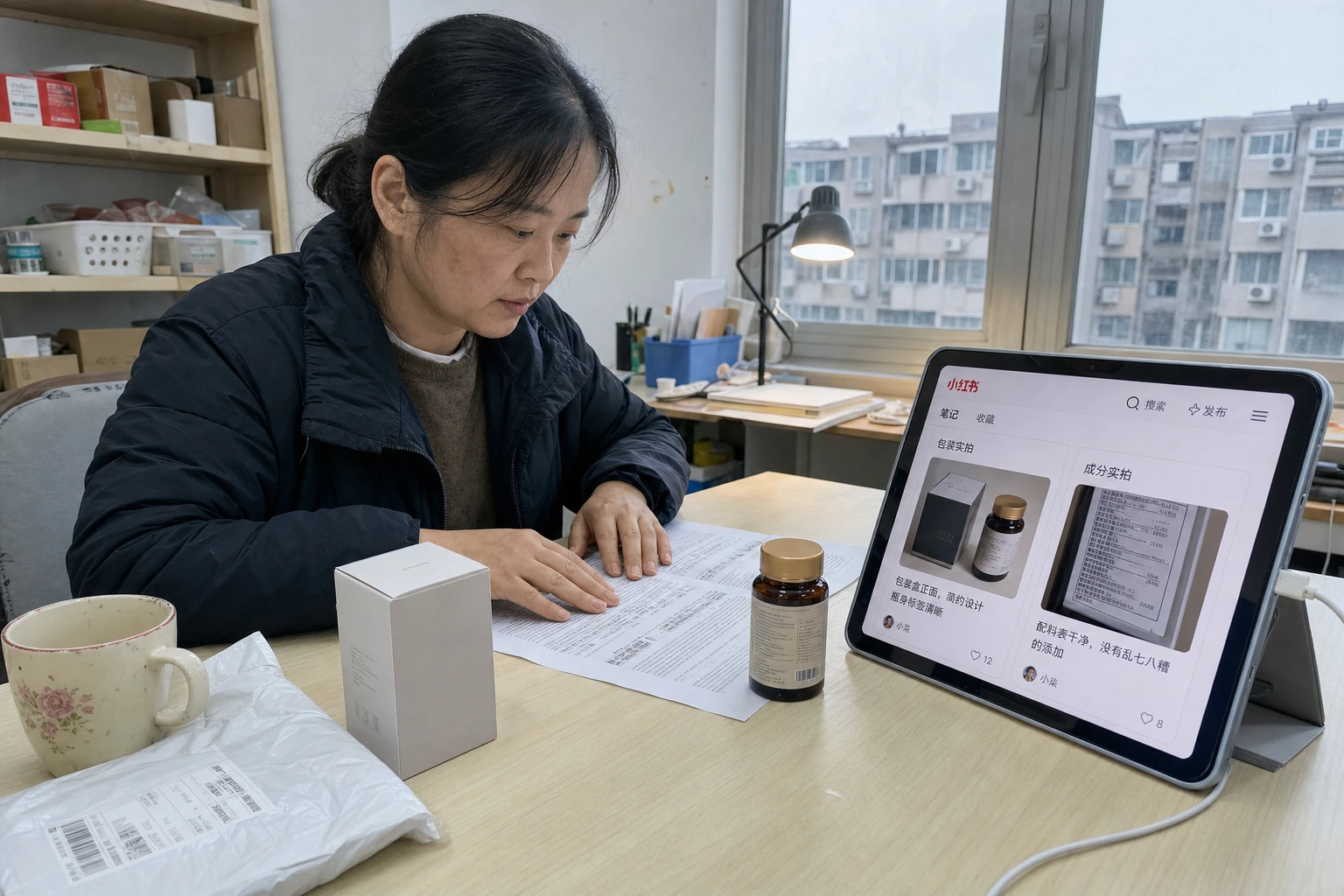
Start your research on Xiaohongshu (小红书), also called RedNote. Search the Chinese ingredient name alongside questions about the label and format. Read what people ask, without treating personal testimonials as clinical evidence. Our RedNote agency page explains the platform work.
Use Douyin (抖音) to study the questions that surface during product demonstrations. Review WeChat (微信) customer-service questions for gaps in the information you already provide. These are proposed research roles, not a ranking of supplement sales by platform.
Market estimates need a clear category definition.
iiMedia Research estimates China’s broad health-products market at 377.5 billion yuan in 2025. Its category is 保健品, not a separately measured market for your supplement type. Source: iiMedia Research (艾媒咨询), January 2026. https://www.iimedia.cn/c1094/109207.html
Use that estimate as context. It does not tell you demand for a particular formula, its legal route, or what an order will cost to acquire.
Build trust with information people can check
Start with the pack. A buyer should be able to read its contents and origin without hunting through promotional images. Where a product record applies, explain how to check it. Storage instructions belong beside the product information, with a clear way to reach customer support.
A laboratory photo does not establish that the advertised product works.
Keep general health education separate from a disguised sales pitch.
Internet rules prohibit disguised health-food ads presented as wellness education. Such education must not share a page or appear simultaneously with related seller contact details or shopping links. Source: State Administration for Market Regulation, Internet Advertising Measures, Article 8, February 2023. https://www.samr.gov.cn/zw/zfxxgk/fdzdgknr/fgs/art/2023/art_d93a579afd45413e8576e4623fab348f.html
Removing the shopping link alone does not establish that a post is lawful. Review its commercial purpose and full presentation. A doctor’s costume, patient story, or dramatic before-and-after sequence can change what the viewer understands.
For planning, keep a claim sheet beside the content calendar. Record the proposed wording, evidence, product record, reviewer, and approved asset version. When a claim is refused, remove it from every brief that repeats it.
KOC seeding needs a different brief here
A key opinion consumer, or KOC, is a small creator whose appeal often rests on personal experience. That appeal creates a problem for health-food ads: the law prohibits endorsers, including ordinary people making recommendations.
Do not commission “this fixed my sleep” posts and assume a modest follower count makes them acceptable. An advertising label does not legalize a prohibited endorsement. Nor does gifting the product settle the issue.
Creators can produce assets without becoming product endorsers. Define that role before agreeing on volume. Producing an approved product image differs from recommending the product under the creator’s own name. Have the final format checked before paying for distribution.
Health-food internet ads require prior review and must follow the approved content. Linked promotional reviews must be identifiable as advertisements. Source: State Administration for Market Regulation, Internet Advertising Measures, Articles 7 and 9, February 2023. https://www.samr.gov.cn/zw/zfxxgk/fdzdgknr/fgs/art/2023/art_d93a579afd45413e8576e4623fab348f.html
For a cross-border item, get a product-specific answer before commissioning testimonials. The store’s ability to take an order is not that answer.
Check the cross-border channel before buying traffic
The positive list names goods eligible for this route, subject to its conditions. Begin with the exact product and its customs classification. “Supplements are allowed” is too broad to approve a range.
The 2022 positive-list adjustment changed tariff codes and product remarks as well as adding goods. It took effect on March 1, 2022. Source: Ministry of Commerce, cross-border retail import list announcement, February 2022. https://www.mofcom.gov.cn/zwgk/zcfb/art/2022/art_7256ee87a5b54b8f9660b4f9dfce848c.html
Confirm the applicable list entry and restrictions, then the store’s current category requirements. Choose a fulfillment route that can produce the required customs information. Check the applicable purchase limits and tax conditions as well. A social account alone does not do this.
Before sending traffic, check the customer journey yourself. Can the buyer understand the product information, delivery route, and return process? Who answers when the package differs from the domestic version they expected?
The cross-border notice requires a consumer risk notice and provides for Chinese electronic labels where goods lack Chinese labels. Sellers retain quality, recall, and consumer-protection duties. Source: Ministry of Commerce and five other departments, Notice 486, November 2018. https://cws.mofcom.gov.cn/gztz/art/2018/art_b7becbacb58a4d0d8bf17b91a168f044.html
The customer must accept the risk notice before ordering. Include that checkout step in the launch plan, along with the ban on resale.
What the marketing scope should include
Ask for a scope that names the route and the product range. Content volume comes after that. Assign claim checks to a named reviewer, then price the Chinese production and account work. Distribution and reporting also need defined deliverables. Who can approve a changed claim should be clear.
TheRedScroll’s China Market Entry and Content Production services can sit within that plan. Product registration, laboratory testing, legal review, and fulfillment need explicit budgets and owners; don’t assume a social media fee includes them. A marketing contract cannot guarantee regulatory approval.
TheRedScroll publishes a full rate card on its pricing page. The commercial model is fixed scope and fixed price, with ad spend billed separately and no markups. Contracts have a six-month minimum.
For an existing account, start by auditing the published claims and order path. Report only what reliable records support: approved content and qualified store visits, then completed orders and refunds. Treat saves as interest, not proof of sales or health outcomes.
Bring your formula, current product documents, proposed sales route, and Chinese content to the first discussion. Use them to set the scope before booking a campaign.
Want to see what this looks like for your brand?
Book a callFAQ
Frequently asked questions
Straight answers to the questions we hear most on this topic.
Not every product follows the same route. General-trade health foods usually need registration or qualifying filing. Eligible cross-border retail imports for personal use receive specific first-import exemptions. Establish the product’s Chinese classification before choosing a route. A foreign supplement label alone does not establish eligibility or permission to make health claims.
For health foods, stay within the registered or filed product record and obtain the required advertising approval. Disease prevention and treatment claims, efficacy guarantees, and endorsements are prohibited. Ordinary food cannot claim health functions. Cross-border import relief does not approve overseas marketing language. Review the full ad, including images and links.
Potentially, if the exact product meets the current positive-list conditions and the retail-import rules. Confirm customs classification, platform admission, and consumer disclosures before launching. The goods are for personal use and cannot be resold. This route does not automatically permit domestic distribution or approve health claims in Chinese marketing.