Industry
Food and beverage marketing in China
Food in China is sold twice: once to the shopper who eats it, once to the chef who cooks with it. Each buyer needs a different plan.
Food in China is sold twice: once to the shopper who eats it, once to the chef who cooks with it. Each buyer needs a different plan.
Most foreign brands arrive with one approach for both. That is the first mistake in food and beverage marketing in China. A shopper decides in seconds, on a phone, from a recipe or a short video. A chef decides over months, after seeing the product work in a kitchen like theirs.
Neither buyer cares much about the claims you make at home. Many of those claims are also illegal here. If you have not launched yet, start with the label section below. If you are already posting and sales are flat, start with recipes and Douyin.
| Retail consumer | Foodservice B2B | |
|---|---|---|
| Who buys | Shoppers, on their phones | Chefs, bakers, buyers at distributors |
| How they decide | Recipe or video, then an impulse buy | Technique, trial, then a standing order |
| Main platforms | Xiaohongshu (小红书), Douyin (抖音) | WeChat (微信), live demos, trade events |
| Content that works | Recipes and pairings with local food | Step-by-step methods, ratios, timing |
| What you measure | Saves, store clicks, repeat orders | Inquiries, samples, orders from distributors |
Every source on this page was checked twice in September 2026. We recheck the label rules each quarter, because one of them changes in March 2027.
Two different games: the shopper and the chef
The imported food market is large, and it’s flat.
China imported 125.4 billion US dollars of food in 2025, down 0.6%. Imports from Europe fell 6.3%, to 24.05 billion US dollars. Source: Ministry of Commerce (商务部) and China Chamber of Commerce for Import and Export of Foodstuffs (中国食品土畜进出口商会), December 2025 report, March 2026. http://wms.mofcom.gov.cn/ncp/shipin_202512.pdf
In a flat import market you win share from other brands, not from new demand. The shelf side is still growing, though.
Retail sales of grain, oil and food rose 9.3% in 2025 at larger retailers. Catering revenue reached 5.8 trillion yuan (57,982 hundred million yuan), up 3.2%. Source: National Bureau of Statistics of China (国家统计局), 2025 Statistical Communique, February 2026. https://www.stats.gov.cn/sj/zxfbhjd/202602/t20260228_1962662.html
That second number is the foodservice market. Think restaurants, bakeries, hotel kitchens and tea shops. It buys through distributors, and it listens to chefs.
Langnese, the German honey brand, already had distribution and shelf space in China when we started. Our consumer research in tier-one and tier-two cities found a hard problem. Shoppers in tier-two cities did not see why imported honey should cost more, when domestic brands cost half as much.
Our answer was not a louder “German quality” message. It was new reasons to buy, tied to real use. Young professionals got honey in their coffee and smoothies. Parents got a natural sweetener. Home cooks got honey as an ingredient. The full plan is in the Langnese case study on our site.
Labels and health claims: what you cannot say
Imported food marketing in China starts with the pack. A product without a Chinese label does not clear customs.
Imported prepackaged food must carry a Chinese label that names the country of origin and the domestic agent. Without it, the food may not be imported. Source: Food Safety Law of the People’s Republic of China (中华人民共和国食品安全法), Article 97, as amended September 2025. https://policy.mofcom.gov.cn/claw/clawContent.shtml?id=104105
Then the post. Food marketing in China can’t promise a health outcome. That rules out most of the wellness copy foreign brands bring with them.
Ordinary food is not medicine. Claims such as dissolving nodules or lowering uric acid break Advertising Law Article 17 and Food Safety Law Article 73. Only registered health food may claim functions such as boosting immunity. Source: Beijing Administration for Market Regulation (北京市市场监督管理局), October 2025. https://scjgj.beijing.gov.cn/zwxx/scjgdt/202510/t20251021_4234743.html
Registered health food carries a small blue hat logo (小蓝帽). If your product does not have one, it cannot claim a health function, anywhere.
A second change is coming, and it hits the clean-label brands hardest.
From March 16, 2027, the new label standard GB 7718-2025 bans “zero added”, “no added” and “not used” wording on packs. Source: Beijing Administration for Market Regulation (北京市市场监督管理局), May 2026. https://scjgj.beijing.gov.cn/zwxx/scjgdt/202605/t20260507_4639154.html
Superlatives are the third trap. The Advertising Law bans “national level”, “highest level” and “best” in any ad.
Ads may not use “国家级” (national level), “最高级” (highest level) or “最佳” (best). Source: Advertising Law of the People’s Republic of China (中华人民共和国广告法), Article 9, text as amended 2021. https://www.gov.cn/guoqing/2021-10/29/content_5647620.htm
These are the claims clients ask us about most. Here’s what survives.
| What you want to say | Why it fails in China | What to say instead |
|---|---|---|
| Boosts immunity | Health function, health food only | What is in it, and how much |
| Lowers cholesterol | Disease claim, banned for food | The ingredient list, plainly |
| Zero added sugar | Banned on packs from March 2027 | Sugar per 100 grams, stated |
| The best honey in the world | Absolute term, Advertising Law | A sourced fact with a date |
| Good for digestion | Health function, health food only | A recipe, and when to eat it |
In short, talk about the food, and leave the body out of it.
Recipes do the selling
Chinese shoppers don’t want to hear about your product. They want to know what to cook with it tonight.
The platform agrees. Xiaohongshu (小红书) writes it into its rules: notes that read like a brand’s own copy are a problem.
Xiaohongshu’s Community Norms list notes that follow merchant guidance too closely or use too many official promotional lines as content it does not encourage. Source: Xiaohongshu (小红书), Community Norms (小红书社区规范), updated December 2021. https://agree.xiaohongshu.com/h5/terms/ZXXY20221213003/-1
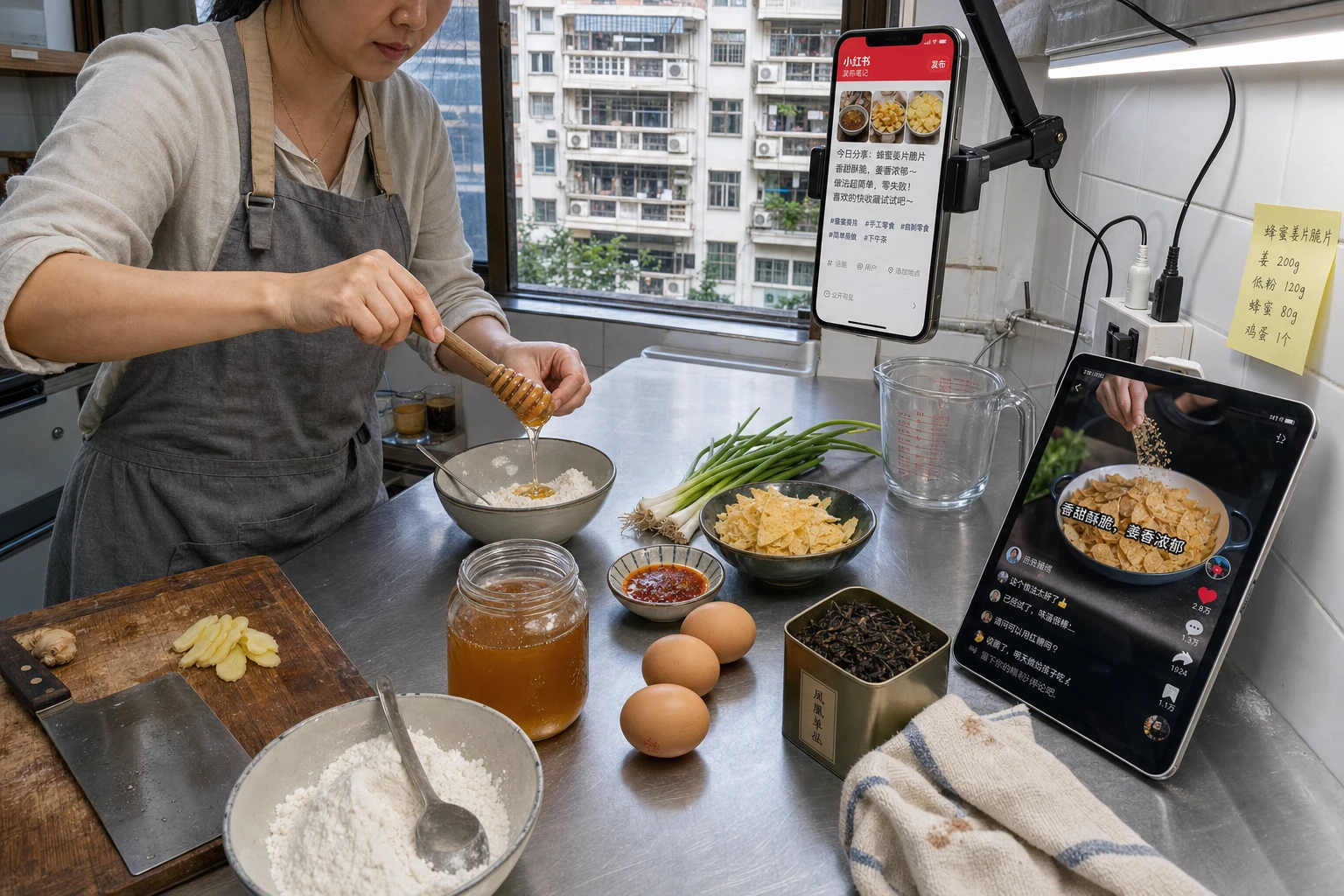
A recipe gets around that. It’s useful, so people save it, and the product sits in the middle of it, unsold. That’s most of what works in food content in China. (It is also the first thing cut when budgets tighten, since a recipe needs a kitchen, a cook and a morning.)
We have no controlled test that pits recipes against product posts. What we have is three food clients, and recipes carried all three. The strategy we built for Langnese gave Xiaohongshu one job: “recipe integration and daily routines”. Mission Foods launched corn chips to Gen Z in a country where most shoppers had never tried one. We paired the chips with dipping sauces and hotpot. That answered the only question that mattered: how do I actually eat these?
Clean eating is the mood recipes now have to match.
The clean eating topic (#干净饮食) on Xiaohongshu passed 1.4 billion views. Source: Qiangua Data (千瓜数据) and First Food Information (第一食品资讯), via TopMarketing, November 2025. https://www.itopmarketing.com/info21430
If your ingredient list is short, that trend works for you. Put the list in the recipe photo and leave “zero added” off the caption.
Douyin and the impulse buy
Xiaohongshu (小红书) is where shoppers plan. Douyin (抖音) is where they buy on a whim, mid-scroll.
Douyin e-commerce GMV grew 34% from August 2024 to July 2025. Shelf e-commerce (货架电商), where shoppers search the store, grew 49%. Source: 36Kr (36氪), September 2025. https://www.36kr.com/p/3480136952077441
Food suits that. Test a 20-second clip first: a snack being opened, dipped or poured, nothing more. Our Langnese plan used Douyin “for quick demonstrations of new use cases”. We also recommended smaller trial sizes and single-serve packs. Both lower the cost of saying yes.
The shelf number matters too.
A shopper who saw your clip last week may come back and search the Douyin store for you. Keep it stocked, with product titles in plain Chinese. And open the store before the first clip goes out, not after, or the traffic has nowhere to go. Already posting, with views but no orders? Check the store link on the clip before you touch the content.
Reaching chefs and distributors on WeChat
Chefs follow people who can cook. An ingredient brand earns a place in that feed by teaching something.
In China, that conversation usually happens on WeChat (微信).
WeChat, counted together with its international version, had 1.418 billion monthly active accounts at the end of 2025. Source: Tencent Holdings 2025 results, via Tencent News (腾讯新闻), March 2026. https://news.qq.com/rain/a/20260318A07APT00
An overseas company gets one Official Account, and it has to be a service account. That sets the pace.
An overseas entity may register one Official Account, and overseas regions support the service account type only. Source: Tencent customer service (腾讯客服), overseas service account registration, confirmed September 2026. https://kf.qq.com/faq/180312zQjeYV180312FNNbmA.html
A service account can push to followers 4 times per calendar month. Source: Tencent customer service (腾讯客服), service account rules, confirmed September 2026. https://kf.qq.com/faq/120911VrYVrA131025QniAfu.html
Four pushes a month is not many, so each one has to earn its place. We would spend one on a technique article with exact ratios before we spent one on a launch.
Our clearest model for this is not a mainland China case, and we’d rather say so. Master Martini has supplied professional bakers and pastry chefs since 1982. For them we ran Instagram and Facebook in Malaysia, Hong Kong, Singapore, Indonesia and Thailand. Recipe content was the backbone. Live sessions with well-known pastry chefs covered “ratios, temperatures, timing”. User contests and workshops did the rest, and product inquiries and orders increased. You can read how it ran in the Master Martini case study. The platform was different. The chefs were not, and neither was what they wanted: technique they could use the next morning.
The same method carries to WeChat. Publish the technique first. Send chefs to a live demo on WeChat Channels (视频号). Then hand distributors a one-page spec sheet in Chinese and a short demo clip they can forward to their restaurant buyers.
The six peaks in China’s food calendar
That’s the year-round work. The calendar decides when it pays off.
Food sales in China move with the festivals, and the content has to start weeks before the day itself.
| Peak | When | What sells | When we start content |
|---|---|---|---|
| Spring Festival (春节) | Late January or February | Gift boxes, snacks, drinks for family meals | Six weeks out |
| 618 mid-year sale | Late May to June 18 | Pantry stock-ups, imported snacks | Early May |
| Dragon Boat Festival (端午节) | May or June | Zongzi (粽子) and gift sets | Four weeks out |
| Qixi (七夕) | August | Chocolate, wine, desserts | Three weeks out |
| Mid-Autumn Festival (中秋节) and National Day (国庆节) | September or early October | Mooncakes (月饼), gift boxes, travel snacks | Six weeks out |
| Singles’ Day (双十一) | Presales in October, peak November 11 | Bulk buys, bundles, trial packs | Early October |
Singles’ Day is the peak with hard numbers attached.
All-platform sales during Singles’ Day 2025 reached 1.695 trillion yuan (16,950 hundred million yuan), up 14.2%. Source: Jiemian (界面新闻), citing Syntun (星图数据), November 2025. https://www.jiemian.com/article/13657537.html
Some peaks are newer than the calendar suggests. Mission Foods’ standout campaign was Halloween, framed as a party-snack moment for Gen Z. It drove a sharp spike in followers and engagement on all three of its platforms. That campaign is written up in the Mission Foods case study.
Food and beverage marketing in China: what a package includes and costs
Every package on our pricing page covers four platforms each week: WeChat (微信) articles, Weibo (微博) posts, Xiaohongshu (小红书) notes and Douyin (抖音) videos. It also includes a competitor study in month one, a content strategy, a monthly editorial calendar and a monthly performance report.
For food brands, two additions come up often. Content Production covers real-life shoots in China, which recipe content needs. Influencer Marketing covers creator campaigns, KOL and KOC (key opinion leaders and everyday consumer creators). Ad spend is paid directly to the platform, not through us.
Our pricing page lists every package and per-item rate, so you can size a budget before you call anyone. Few agencies do that.
0 out of 37 agencies analyzed offer fixed-price packages. Source: TheRedScroll competitive analysis, April 2026.
Four things move the cost: platforms, posts per week, real shoots or AI production, and your influencer and ad budgets. Contracts run six months at minimum. The first content goes live within two weeks of signing.
Book a call
Tell us what you sell, who buys it and where it is stocked today. We will tell you which buyer to chase first and what the first six months look like.
Want to see what this looks like for your brand?
Book a callFAQ
Frequently asked questions
Straight answers to the questions we hear most on this topic.
Almost none. Ordinary food cannot claim to prevent or treat disease, and it cannot claim a health function such as boosting immunity. Only registered health food, marked with the blue hat logo (小蓝帽), can do that. From March 2027, "zero added" wording is banned on packs too. What you can say is what the food is, where it comes from and how to cook with it.
For most consumer brands, Xiaohongshu (小红书) comes first. Shoppers search it for recipes and food ideas, and a good note keeps working for months. Add Douyin (抖音) once the store is stocked, since short demos sell snacks and drinks on impulse. WeChat (微信) is for foodservice buyers and for keeping the shoppers you have won. A brand that only sells to kitchens can start on WeChat alone.
Through people chefs trust. Run technique content with exact ratios and temperatures, host live demos with known chefs, and invite chefs to share their own dishes. WeChat (微信) carries it, because chefs and distributors already work there. Our Master Martini case shows the method, run across five Asian markets on Instagram and Facebook.