Industry
Fashion and apparel marketing in China
How fashion and apparel brands get found, tried and bought in China, and the case that took Camper to 187K followers in just 18 months.
Chinese shoppers find clothes by searching for the outfit, not the brand. The brands that grow are in that search, and their clothes fit the way the note promised.
A foreign brand usually comes to a fashion marketing agency in China with one of two problems. It has not launched yet and wants to know which platform to open first. Or it has been posting for a year, the follower count moves, and the stores do not.
Both problems have the same root. In China, clothes are discovered as outfits, in search, on Xiaohongshu (小红书). They are sold on camera, on Douyin (抖音) and in Xiaohongshu live rooms. And they are returned at rates no other category comes close to. A plan that covers the first two and ignores the third loses money on every sale it makes.
Camper, a footwear brand whose China accounts we run, went from 43,000 to 187,000 followers in 18 months and lifted same-store sales 31%. The full case is on our site. Here is the shape of the plan, platform by platform.
| Platform | Its job for a fashion brand | What it needs from you |
|---|---|---|
| Xiaohongshu (小红书) | Discovery. Outfit notes that rank for the searches your buyer types | Product on real people, sizing answers, a store that can take the order |
| Douyin (抖音) | Volume. Short video and live rooms that sell in the moment | Stock, a host who knows the fit, a returns plan |
| WeChat (微信) | Retention. The buyers you already have, and the longer brand story | An Official Account, a store link, a CRM |
| Weibo (微博) | Conversation. Launches, collaborations, the argument around a design | A point of view worth arguing about |
Every source on this page was checked twice in September 2026. We review the page each quarter, because the return-rate figures move every festival.
What changed for foreign fashion brands in China
Three things changed at once, and most foreign brands planned for one.
The first is where the growth went. Store sales in fashion barely move. Online sales of clothing still do.
Retail sales of clothing, footwear, hats and knitwear grew 3.2% in 2025 across units above the designated size, below total retail growth of 3.7%. Online retail of physical goods reached 130,923 hundred million yuan, or 26.1% of all retail sales. Source: National Bureau of Statistics of China (国家统计局), 2025 Statistical Communique, February 2026. https://www.stats.gov.cn/sj/zxfb/202602/t20260228_1962662.html
From January to July 2026, online sales of clothing grew 5.8% while total retail sales grew 1.2%. Source: National Bureau of Statistics of China (国家统计局), January to July 2026 retail release, August 2026. https://www.stats.gov.cn/sj/zxfb/202608/t20260817_1965052.html
The second is where the online growth went: to the video apps, and inside them, more and more to their own shelves and search.
Douyin e-commerce gross merchandise value grew 34% from August 2024 to July 2025, and its shelf sales, the search and store side of the app, grew 49%. Source: 36Kr (36氪), September 2025. https://www.36kr.com/p/3480136952077441
Live commerce sales in China reached 69,461 hundred million yuan in 2025, up 30.42%, with 660 million users. Source: 100EC (网经社), China Live Commerce Market Data Report 2025, May 2026. https://www.100ec.cn/detail--6659027.html
The third is the return rate. It decides whether the first two make any money, and it gets its own section below.
If you have not launched: this is good news, because a brand with no stores can still be found. If you are in market and the numbers are flat: the growth is real. It is just not on the surface you have been posting to.
Camper: 43K to 187K followers and a 31% sales lift
Camper has made shoes in Mallorca since 1975. When it came to us, it had 43,000 followers across WeChat (微信), Weibo (微博) and Xiaohongshu (小红书). Engagement sat at 1.2%. The stores in first-tier cities were getting no help from social media.
The brief was growth without discount campaigns. So the content was about the shoes. Why they are built the way they are. Who designs them. How people in Chinese cities actually wear them. On Xiaohongshu we worked with smaller creators in architecture, interiors and design rather than fashion accounts. On WeChat we ran short documentaries from the workshops. On Weibo, one thread about whether a shoe should be designed for how it feels or how it looks ran for three days.
| Measure | Before | After 18 months |
|---|---|---|
| Followers, three platforms combined | 43,000 | 187,000 |
| Engagement rate | 1.2% | 4.7% |
| Same-store sales, year on year | baseline | up 31% |
Camper grew from 43,000 to 187,000 followers in 18 months. Engagement rose from 1.2% to 4.7%. Xiaohongshu drove 38% of e-commerce traffic from the smallest of the three audiences, and same-store sales grew 31% year on year. Source: TheRedScroll, Camper case study, September 2026. https://www.theredscroll.com/work/camper/
Two details matter more than the headline. Xiaohongshu had the smallest follower count of the three and sent the most store traffic. And the first months were slow. The Camper case study on our site has the full timeline.
Our Camper teardown goes further: the three formats, the weekly reporting and what we would change today.
The discovery path: Xiaohongshu to Douyin to store
A Chinese shopper rarely types a brand name. She types the outfit. Autumn commute jacket. Wide-leg pants for short legs. Loafers with socks. Xiaohongshu (小红书) is where that search happens.
Xiaohongshu passed 400 million monthly active users and 800 million searches a day. Source: Xiaohongshu, Video Creator Trend Observation Report, reported by Beijing Business Today (北京商报) via Sina Finance (新浪财经), May 2026. https://finance.sina.com.cn/jjxw/2026-05-27/doc-inhziqxq9291575.shtml
77% of Xiaohongshu’s daily active users use search to solve a problem. Source: Huxiu (虎嗅), May 2026. https://www.huxiu.com/article/4861801.html
39 million users a day show product purchase-seeking behavior on Xiaohongshu, 140 million instances a day. Source: 36Kr (36氪), reporting Xiaohongshu’s GROW merchant conference, April 2026. https://www.36kr.com/newsflashes/3758099821871879
The path, as we see it across the accounts we run, has four steps.
- She searches Xiaohongshu for the outfit, not the brand.
- She reads three to five notes, mostly from people who bought the item, and the comments under them. The comments are where the sizing questions live.
- She buys inside the app, or opens Douyin (抖音) to see the item moving on camera, or walks into a store with a screenshot.
- She keeps it, or sends it back.
Step two is where a foreign brand usually disappears. Its notes are studio shots with no body in them, no size in the caption, and no answer in the comments. Our RedNote Agency page covers how we build notes that hold a search result. The point here is simpler: step three cannot happen if step two shows nothing.
Outfit content and the scenario sell
Fashion content in China sells a situation, not a garment. The note is “what I wore to a tea house in Chengdu in October,” and the product is one item in it. This is zhongcao (种草), the planting of a want, and in fashion it is done almost entirely through outfits on real bodies.
The platform’s own numbers show why the style beats the product as a search term.
During the 2024 618 festival, fashion traffic on Xiaohongshu (小红书) grew 23% year on year, style searches grew 125%, and fashion orders grew 219%. Source: Xiaohongshu (小红书) commercial team, 2025 618 fashion industry guide, data from the Xiaohongshu data platform, hosted by Shuidi Yanbao (水滴研报), April 2025. https://www.sdyanbao.com/detail/880590
Style searches grew five times faster than traffic did. People type old money, quiet luxury or new Chinese style (新中式). The notes that rank for those phrases belong to whoever put a product in that scenario first.
Three things that work:
- One product, five scenarios. The same jacket on a commute, at a wedding, on a weekend walk, in a hotel lobby, on the metro. Five notes, five search terms.
- The creator’s own wardrobe around your product, not a head-to-toe look from your catalog. A full-brand outfit reads as an ad.
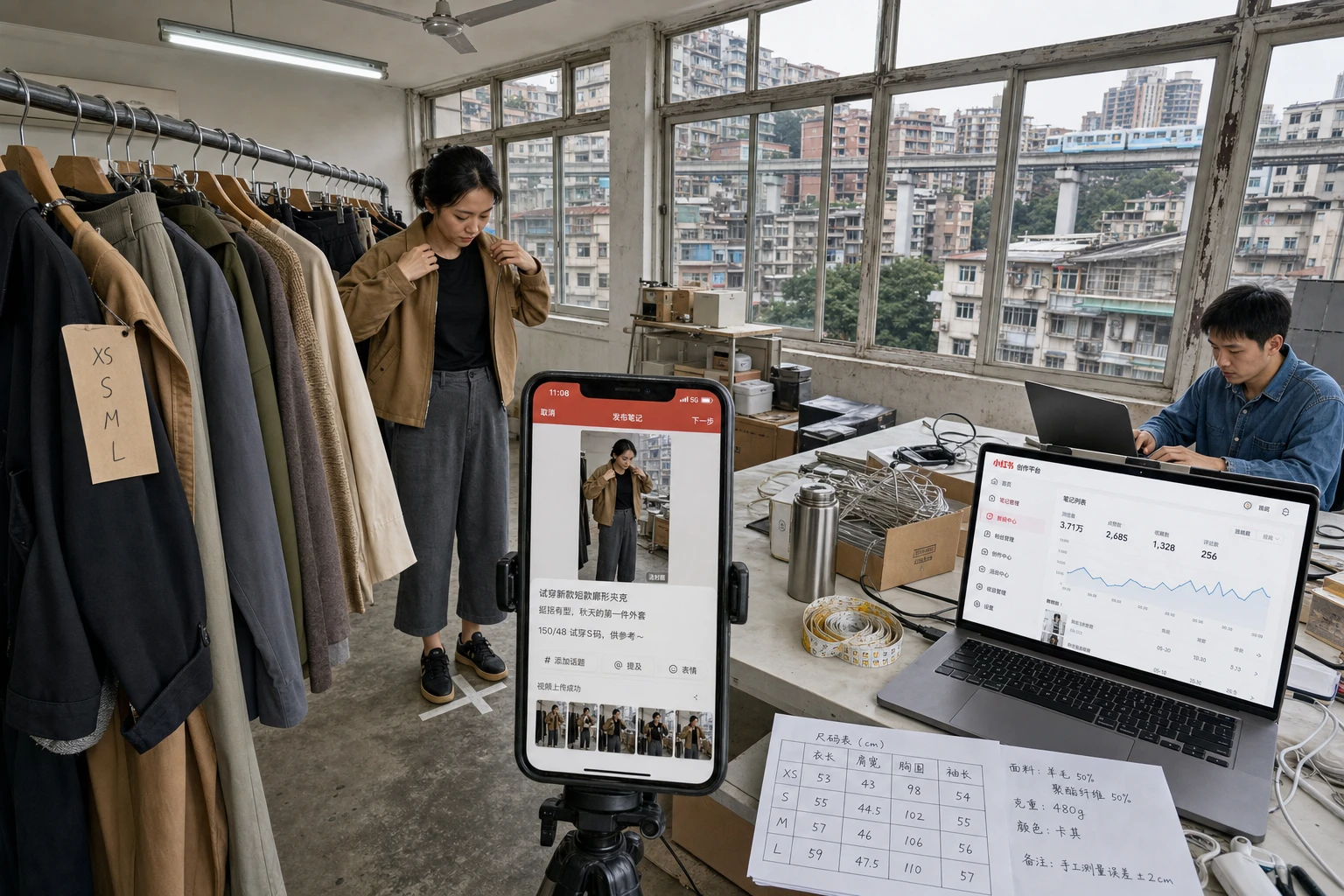
- Height and weight in the caption. Chinese fashion notes carry them by habit, and a note without them gets the same question fifty times in the comments.
Douyin (抖音) runs the same logic at a faster pace.
On Douyin, women’s wear, men’s wear and sports and outdoor led apparel sales growth, each above 10%, with sports and outdoor up 40%. Source: Douyin E-commerce (抖音电商), 2025 autumn and winter brand apparel trend report, hosted by Shuidi Yanbao (水滴研报), May 2025. https://www.sdyanbao.com/detail/886015
The scenario sell there is a 15-second video. The item on a body, walking down a real street, with the size range in the overlay text. Our Douyin platform page covers the formats.
Sizing, fit and returns: the content nobody makes
Here is the number that belongs on the first page of every fashion brand’s China plan.
During the 2025 Double 11 festival, the overall e-commerce return rate was 61.5%, and in apparel livestreaming it passed 80%. Women’s wear return rates online usually sit between 50% and 60%. Source: CCTV News (央视新闻), Weekly Quality Report, carried by Beijing Daily (京报网), January 2026. https://news.bjd.com.cn/2026/01/11/11517038.shtml
On one leading platform, the day-to-day return rate for clothing is about 15% to 20%. Women’s wear livestream returns reached 80% during Double 11 2024, and each returned garment costs the seller about 20 to 32 yuan. Source: Beijing News (新京报), June 2025. https://m.bjnews.com.cn/detail/1750036716129261.html
Clothing is not a standard product. Sizes differ between brands, fabric cannot be judged through a screen, and there is no fitting room. Beijing News lists all three as reasons shoppers send garments back. Foreign brands add a fourth. Their size chart was built for a different body, and a European 38 tells a Chinese shopper nothing she can use.
So the most valuable content a foreign fashion brand can make in China is the content almost none of them make. Fit content.
| The question she has | The content that answers it | Where it goes |
|---|---|---|
| Will it fit me? | The creator’s height, weight and the size worn, in the caption | Every Xiaohongshu (小红书) note, every Douyin (抖音) overlay |
| Is it true to size? | A three-line fit note per product: runs small, runs large, true to size | Product page, pinned comment, live room script |
| What is the fabric like? | Close-up video of the weave, the drape, and the item after one wash | Video notes, short video |
| How does it look on my body type? | The same product on three creators with different builds | The seeding plan, not one hero shot |
| Can I return it? | The policy in plain words, before the purchase | Store page, live room, comments |
None of this is glamorous, and all of it cuts returns. In fashion the return is where the profit goes. A note that answers the fit question is worth more to the brand than a note that only wins the click.
Live commerce for fashion: when it works
Live commerce is the biggest channel in Chinese fashion and the one with the worst returns. Those are the same fact.
Live commerce had close to 600 million users in China in 2024, and its penetration rose from 4.9% in 2019 to 37.8%. Source: China Federation of Internet Societies (中国网络社会组织联合会) and China International Electronic Commerce Center (中国国际电子商务中心), China New E-commerce Development Report 2025, carried by the Cyberspace Administration of China (网信办), July 2025. https://www.cac.gov.cn/2025-07/28/c_1755417344368120.htm
Sales across all platforms during the 2025 Double 11 (双十一) period reached 16,950 hundred million yuan, up 14.2%, and sports and outdoor, beauty and apparel were the three fastest-growing categories in the first phase. Source: Jiemian (界面新闻), citing Syntun (星图数据), November 2025. https://www.jiemian.com/article/13657537.html
It works for fashion in three cases. Basics and repeat buys, where the shopper already knows her size in your brand. Sports and outdoor, where the product demonstrates on camera. And a fixed drop, where the limited run does the selling.
It fails when a host who has never worn the product reads a size chart from a card. The returns come back a week later, and the law makes the brand answerable for what the host said.
A seller promoting goods through an internet livestream, where this amounts to commercial advertising, takes on the duties of an advertiser. Livestream room operators and livestream marketing staff take on the duties of an advertising operator and publisher when commissioned to do so. Source: State Administration for Market Regulation, Internet Advertising Measures (互联网广告管理办法), Order 72, Article 19, in force May 2023. https://www.gov.cn/gongbao/2023/issue_10506/202306/content_6885261.html
Premium fashion has one more decision to make. A live room that discounts trains the audience to wait for the next discount. Camper ran no discount campaigns in 18 months and grew anyway. For a premium brand, the live room’s job is the fit demonstration and the questions, and the price stays where it is. Our guide to live commerce in China covers the formats and the costs.
What a fashion marketing agency in China includes, and what it costs
That is the plan. Here is what it takes to run it.
A fashion scope draws on four of our seven services. Strategy, Campaigns and Analytics for the search-term research: which outfit phrases your buyer types, and which of them nobody owns yet. Content Production for the notes and the short video, shot on real people in Chinese cities with the size in the caption. Influencer Marketing for seeding through Pugongying, the creator marketplace Xiaohongshu (小红书) runs, so every paid note is declared. Advertising once there are notes worth putting money behind. CRM and Private Domain Traffic joins later, when there are buyers to keep.
Three costs sit outside the retainer and move the total more than the retainer does.
Pugongying charges 10% of the deal in standard mode and 20% in the premium mode that adds platform promotion. Source: Niaoge Biji (鸟哥笔记), October 2022. https://www.niaogebiji.com/article-482538-1.html
Nano KOC accounts with 1,000 to 5,000 followers run about 20 to 60 US dollars per post, while micro KOL work under 1 million followers runs about 10,000 to 35,000 US dollars per campaign. Source: Long Advisory, June 2026. https://longadvisory.eu/en/kol-vs-koc-marketing-in-china-which-delivers-better-roi/
Creator fees scale with the number of scenarios and search terms you want to own. Samples are the second (and in fashion a sample goes out as a size run, not one piece per creator). Ad spend is the third, billed at cost with no markups.
TheRedScroll works on a fixed scope and a fixed price, with a six-month minimum, because a Xiaohongshu search position takes a season to earn. The full rate card is on our pricing page. When we checked the market in April 2026, that was still unusual.
0 out of 37 agencies analyzed offer fixed-price packages. Source: TheRedScroll competitive analysis, April 2026.
The process is a 30-minute call, a fixed-price proposal, then accounts and first content in two weeks.
Fourteen days from signed contract to first post going live. Source: TheRedScroll, September 2026. https://www.theredscroll.com/
Reporting is monthly. It reports search rank by outfit term, store traffic by platform, and the return rate on what social sold. Impressions go in the appendix.
Read the Camper case, then Book a call
Read the Camper case study first. Then tell us your category, your size range and where you sell today. We will tell you which platform to open first and what the first six months look like.
Want to see what this looks like for your brand?
Book a callFAQ
Frequently asked questions
Straight answers to the questions we hear most on this topic.
Xiaohongshu (小红书). It is where Chinese shoppers search for outfits, and a note that ranks for an outfit phrase keeps sending buyers for months. Camper's Xiaohongshu account had the smallest audience of its three platforms and sent 38% of e-commerce traffic. Add Douyin (抖音) once you have stock, a host who knows the fit and a returns plan. WeChat (微信) comes last, to keep the buyers you have won.
Yes, when the live room demonstrates fit and answers questions instead of cutting the price. A premium brand that discounts on camera teaches the audience to wait for the next stream. Apparel livestream returns passed 80% during Double 11 (双十一) 2025. The room has to be run by someone who has worn the product and can say who it fits. Basics, sportswear and limited drops do best.
There is no market benchmark, so we answer with the case we can show. Camper's first months were slow. Over 18 months, followers went from 43,000 to 187,000 and same-store sales rose 31% year on year. Search positions on Xiaohongshu (小红书) take about a season to earn, which is why the contract runs six months at minimum. A sales lift promised in eight weeks is a discount, not a plan.