Industry
Travel and hospitality marketing in China: a hotel marketing agency's guide
Chinese travelers choose a trip on Xiaohongshu (小红书) and Douyin (抖音), then book it on Trip.com (携程), Fliggy (飞猪), or Meituan (美团). A hotel or destination has to show up in both places, or the research ends in someone else's booking.
Chinese travelers choose a trip on Xiaohongshu (小红书) and Douyin (抖音), then book it on Trip.com (携程), Fliggy (飞猪), or Meituan (美团). A hotel or destination has to show up in both places, or the research ends in someone else’s booking.
Most foreign hotels treat China as one channel. They post on social, or they load rates onto an online travel agency (OTA), and nothing joins up. A hotel marketing agency in China spends its time on the gap between the two. Here’s who does what.
| Platform | Job in the trip | What you set up | What you measure |
|---|---|---|---|
| Xiaohongshu (小红书) | Choosing where to go and stay | Itinerary notes, real stays | Saves, searches for your name |
| Douyin (抖音) | Seeing it, sometimes buying it | Short video, hotel deals | Views, deal orders |
| WeChat (微信) | Keeping guests after they book | Service account, member perks | Followers, repeat stays |
| Trip.com (携程), Fliggy (飞猪) | Booking the room or the flight | Listing, photos, rate plans | Bookings, reviews |
| Meituan (美团), Dianping (大众点评) | Checking reviews, booking nearby | Profile, rankings, deals | Rating, review count |
If you haven’t launched yet, read the first two sections. If you are already posting and bookings are flat, start with the OTA layer. Every source on this page was checked twice in October 2026.
How many Chinese travelers go abroad now
The outbound market is nearly back to where it was before the pandemic.
Mainland residents made 148.36 million outbound trips in 2025, up 20.8%. Source: Ministry of Culture and Tourism (文化和旅游部), 2025 statistical bulletin, June 2026. https://zwgk.mct.gov.cn/zfxxgkml/tjxx/202606/t20260602_966073.html
Outbound trips in 2025 were close to the 2019 level. Source: China Tourism Academy (中国旅游研究院), annual outbound travel report, via China Tourism News (中国旅游新闻网), May 2026. https://www.ctnews.com.cn/dongtai/m/content/2026-05/26/content_187728.html
And 2026 is running ahead of 2025 so far.
From January to August 2026, border control checked 499 million crossings, up 8.7%. Mainland residents made 242 million of them. Source: National Immigration Administration (国家移民管理局), September 2026. https://www.nia.gov.cn/n741440/n741567/c1800846/content.html
The mix is shifting, though. Trip.com (携程) told investors in September that shorter trips were taking a bigger share.
Rising oil prices and airfares held back overall outbound growth. Short-haul and visa-free destinations took a larger share of outbound demand. Source: Trip.com Group second-quarter 2026 earnings call, via Southern Metropolis Daily (南方都市报), September 2026. https://m.mp.oeeee.com/a/BAAFRD0000202609161667171.html
If you sell a long-haul destination, read that as a warning. The trip has to earn its airfare, and that case gets made on social media, long before anyone opens a booking app.
The research path: Xiaohongshu to OTA to booking
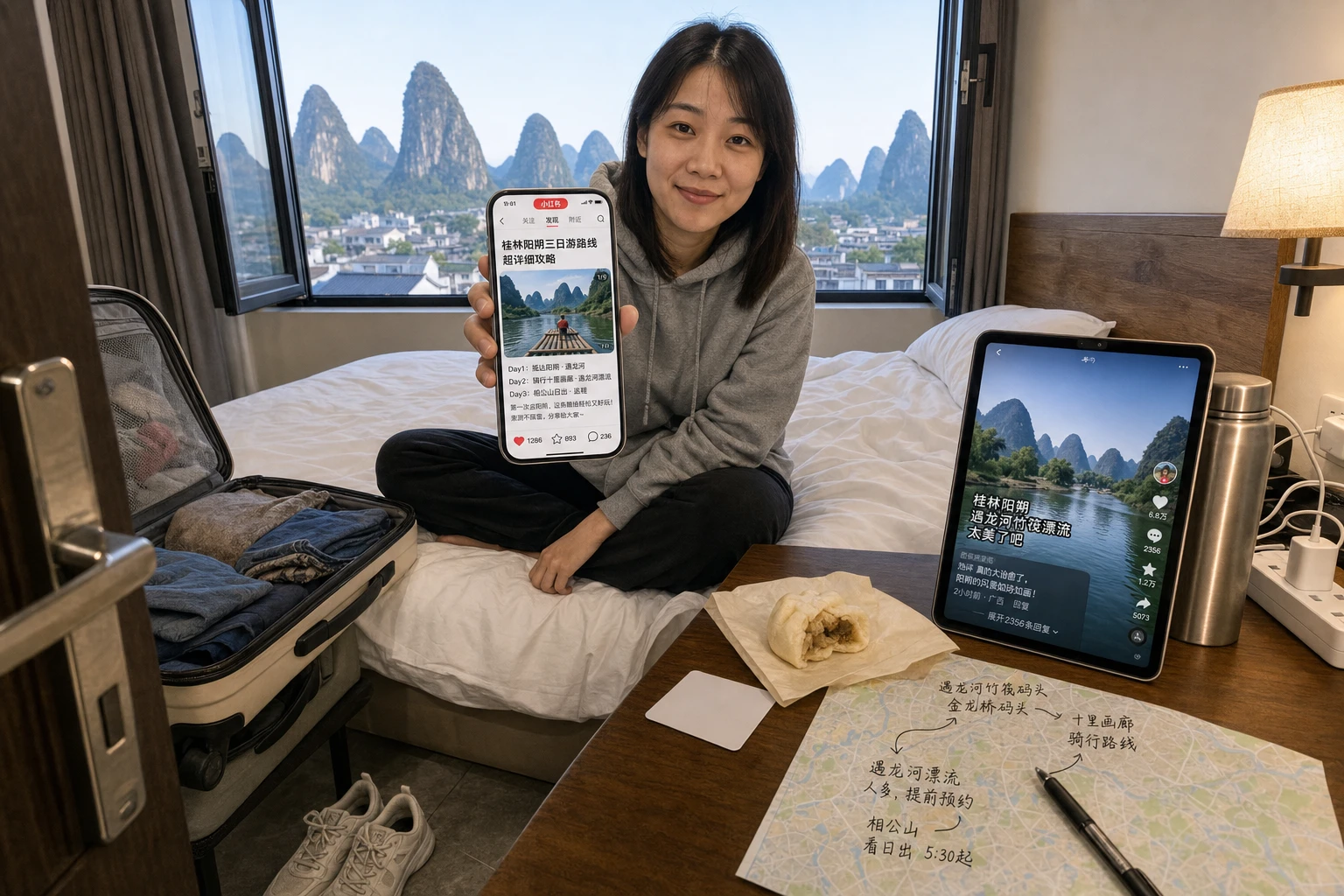
Xiaohongshu (小红书) is where many Chinese travelers start. The platform’s own data shows how many.
Of Xiaohongshu’s 230 million+ monthly users interested in travel, over 80% check travel guides on the app. They made 2.4 billion+ travel searches. Source: Xiaohongshu commercial data, November to December 2025, via TravelDaily (环球旅讯), January 2026. https://www.traveldaily.cn/article/189197
69% of Xiaohongshu users choose a destination based on their interests, and 57% of the travel guides they read are found through search. Source: Fliggy (飞猪) and Xiaohongshu May Day travel report, via Economic Information Daily (经济参考报), May 2026. http://jjckb.xinhuanet.com/20260505/d27f01393793428cab7f47751ad4500a/c.html
That reading begins in the search bar. A traveler types a city, a hotel name, or a question (“Kyoto ryokan with kids”) and reads notes from people who went.
Douyin (抖音) works differently. It shows people a place they weren’t looking for, and lets some of them buy on the spot.
Douyin hotel and travel videos passed 402.5 billion plays, and users searched hotel and travel content more than 67.7 billion times. 32% of the users in the report booked a hotel stay from a live room. Source: Douyin trend report, via China Tourism News (中国旅游报), June 2026. https://www.ctnews.com.cn/dongtai/content/2026-06/18/content_188669.html
Then the traveler leaves social media to book.
Xiaohongshu won’t let you help with that step.
Since March 12, 2025, Xiaohongshu bans links, QR codes, and accounts from other platforms. Deals on the platform go through its own store, live-room cart, or lead form. Source: Sanyi Shenghuo (三易生活), March 2025. https://www.3elife.net/Art/internet/202503/12/101166.html
So a note can’t carry a Trip.com (携程) link. The traveler copies your hotel’s name and searches for it on an OTA. If the Chinese name in your notes doesn’t match the name on your listing, they find a different hotel, or nothing. Check that match before you post anything.
Content that converts: itineraries, not brochures
Few Chinese travelers search for a hotel by name at the start. They search for a trip: “three days in Lisbon”, “where to stay in Hokkaido in winter”. Your content has to answer that question, with your property inside the answer.
Interest drives the choice more than the brand does.
Searches for experience-based travel on Xiaohongshu (小红书) grew 48% over the previous period. Source: Xiaohongshu 2026 interest travel trend report, via China Daily (中国日报网), September 2026. https://cn.chinadaily.com.cn/a/202609/24/WS6ab4fa33e4b09a165c78ca4b.html
A brochure says “luxury rooms and a spa.” An itinerary note says: land at 10 a.m., take the train (here’s the platform number), drop bags, walk 12 minutes to the market, dinner at the place the concierge actually eats at. The hotel appears four times, as part of the trip.
What to put in every travel note:
- A day-by-day route with times and transport.
- Real photos from a real stay. Include the room as you found it, the view from the actual window (not the suite on the brochure), and the breakfast.
- Prices in yuan for the things travelers worry about: the taxi, the meal, the ticket.
- The hotel’s exact Chinese name, the one on your OTA listing.
- Payment and language tips. Can I pay with Alipay (支付宝)? Will staff understand me?
The “real stay” part isn’t optional anymore.
Xiaohongshu’s September 2026 notice on AI-faked content names cultural tourism and lodging among its priority categories, and targets invented stay and visit experiences. Source: Dazhong Net (大众网), September 2026. https://www.dzwww.com/news/yw/202609/t20260903_18082859.htm
The OTA layer: Trip.com, Fliggy, Meituan, and Dianping
The booking itself happens on an OTA. Here’s what each one does for a foreign hotel.
| Platform | Owned by | What it does for you | Set up first |
|---|---|---|---|
| Trip.com (携程) | Trip.com Group | Flights and hotels, at home and abroad | Chinese listing, photos, reviews |
| Fliggy (飞猪) | Alibaba | Brand flagship stores, packages, member deals | Flagship store if you are a group |
| Meituan (美团) | Meituan | Hotel deals inside a daily-use app | Listing, member offers |
| Dianping (大众点评) | Meituan | Reviews and rankings, now abroad too | Profile, photos, review replies |
| Douyin (抖音) | ByteDance | Hotel deals sold inside video | Deal vouchers, live sessions |
Begin with Trip.com, the OTA foreign hotels tend to know already.
Trip.com’s outbound hotel and air bookings passed 140% of 2019 levels in the third quarter of 2025. Source: Trip.com Group results, via Cover News (封面新闻) on Sina Finance, November 2025. https://finance.sina.com.cn/roll/2025-11-18/doc-infxusin2963029.shtml
Fliggy (飞猪) is where big hotel groups build a branded store. Marriott did it early.
On August 7, 2017, Alibaba and Marriott formed a joint venture to run the Fliggy Marriott flagship store, Marriott’s Chinese website, and its Chinese app. Source: 21st Century Business Herald (21世纪经济报道), August 2017. https://m.21jingji.com/article/20170807/herald/ed8d29edc61f6058e2b7eb78abeeec32.html
Meituan (美团) and Dianping (大众点评) belong to the same company, and plenty of foreign hotels leave both out. They shouldn’t. Dianping ranks hotels every year, in public.
Dianping’s 2026 Must-Stay list (必住榜) named 1,418 hotels in 205 cities. Source: Xinhua (新华网), April 2026. http://www.news.cn/tech/20260409/339749bc1a894f48850f1ed0cf71ffee/c.html
And Dianping now follows travelers abroad.
Dianping’s overseas pages cover more than 3,000 cities and get over 110 million visits a year. Source: China Business Journal (中国经营报), via Tencent News, August 2026. https://news.qq.com/rain/a/20260831A09BFG00
Marriott went further in 2025 and tied its loyalty program to Meituan’s.
Marriott and Meituan launched a joint membership. Meituan Black Diamond and Dianping LV8 members become Marriott Bonvoy Gold members. Source: Xinhua (新华网), May 2025. http://www.news.cn/tech/20250528/1dc160bcd48d41bbbd7f468f79f1e01f/c.html
Already posting for months with flat bookings? Search your hotel’s Chinese name on Trip.com and on Dianping, the way a traveler would. Look for a wrong Chinese name first. Then look at the photos, and at how many reviews nobody answered.
Your revenue team usually runs the listings. Our job is to make sure the social side sends people to them, under the same name, with the same photos.
Working with travel KOLs without wasting budget
Travel creators (KOLs, or key opinion leaders) are the obvious way in on Xiaohongshu (小红书) and Douyin (抖音). They are also the easiest way to waste a travel budget.
Before you book anyone, know three rules.
Posts that share an experience or review and carry a purchase link must be clearly labeled “广告” (advertisement). Source: State Administration for Market Regulation (国家市场监督管理总局), Internet Advertising Measures (互联网广告管理办法), Article 9, in force May 2023. https://www.gov.cn/gongbao/2023/issue_10506/202306/content_6885261.html
Online travel operators may not run false promotion, and may not mislead, induce, substitute for, or force travelers’ reviews. Source: Ministry of Culture and Tourism (文化和旅游部), Interim Provisions on Online Travel Business Services (在线旅游经营服务管理暂行规定), in force October 2020. https://www.gov.cn/zhengce/2020-08/20/content_5712506.htm
The third is the AI rule above. A creator who never stayed with you is now a risk to your account, not just a waste of money.
What works instead:
- Host the creator. Pay for a real stay and a real route, not for a follower count.
- Pick mid-sized travel creators whose followers ask “how do I get there” in the comments. That question means intent.
- Brief the route, not the script. Give them the itinerary and let them write.
- Measure what happens in the weeks after. Saves count, and so do searches for your Chinese name. Likes matter less.
Marriott used creators this way around a big sales moment. WeChat (微信), Weibo (微博), and travel KOLs “built anticipation weeks before launch”, according to our Marriott case study, and influencer content “kept energy up through the campaign window”. By launch day, in the page’s words, “the audience was primed.”
Seasonality: Golden Week, Spring Festival, and the summer window
Creators are the who. The calendar decides the when.
Chinese travel runs on public holidays, and the big ones move hundreds of millions of people in a single holiday.
| Window | When | Who travels | Content goes live |
|---|---|---|---|
| Spring Festival (春节) | Late January or February | Families, long-haul and short-haul | Eight weeks out |
| May Day (劳动节) | May 1 to 5 | Couples and friends, short-haul | Six weeks out |
| Summer holiday (暑假) | July and August | Families with school-age children | Early May |
| National Day Golden Week (国庆黄金周) | October 1 to 7 or 8 | Everyone, the year’s peak | Mid-August |
The 2025 National Day and Mid-Autumn holiday ran eight days. Domestic trips reached 888 million. Source: Ministry of Culture and Tourism (文化和旅游部), October 2025. https://www.mct.gov.cn/whzx/whyw/202510/t20251009_962532.htm
Over the 2026 National Day holiday, border control checked 15.462 million crossings, 2.209 million a day, up 6.7%. Mainland residents made 4.444 million outbound trips, up 9.3%. Source: National Immigration Administration (国家移民管理局), October 2026. https://www.nia.gov.cn/n741440/n741567/c1815006/content.html
During the nine-day 2026 Spring Festival holiday, mainland residents made 9.514 million border crossings, about 1.977 million crossings a day overall. Source: National Immigration Administration (国家移民管理局), February 2026. https://www.nia.gov.cn/n741440/n741567/c1766817/content.html
If you haven’t launched yet, pick one window and build toward it, rather than spreading thin across all four. Check these dates against your own calendar. A Chinese peak week can fall in your low season, and that’s the week to push hardest.
Destination marketing versus property marketing
A tourism board and a hotel need different plans.
A destination sells the reason to go. Its content is routes and food and the best month to go, plus the dull questions that decide a trip: how to get a visa, how to get from the airport, whether a phone payment app works in the taxi, and whether anyone at the station will understand a question asked in Mandarin. That content lives on Xiaohongshu (小红书) and Douyin (抖音), mostly through creators. Success shows up first as searches for the destination’s Chinese name, and as arrivals months later.
A destination also has to watch who sells for it. If a campaign sells packaged tours, make sure a proper travel agency sells them, not a creator’s private chat group.
In April 2026 the Ministry of Culture and Tourism and the Cyberspace Administration began a joint campaign against illegal online tour selling, focused on online traffic and private-domain selling. Source: Xinhua, via CCTV (央视网), April 2026. https://news.cctv.com/2026/04/28/ARTIiKuNsbQ5J0fkVe8Yy8k0260427.shtml
A property’s job is narrower: fill rooms. Its content is the stay itself, and it needs an OTA listing that matches. It works on all the platforms above, and on WeChat (微信) for the guests it already has.
Marriott shows the property version at full scale. The group runs “over 9,000 properties across 30 brands”, and its first Super Brand Day on Alibaba was built around something people could buy: an “exclusive Marriott black card with global privileges”. Every channel pointed to one Tmall (天猫) page, where people could “buy the card and sign up for Bonvoy in the same transaction”. The result, in the words of our Marriott case study: “Marriott’s first Super Brand Day generated millions in sales on Tmall. Hundreds of thousands of new Bonvoy members signed up.”
A single hotel can borrow the idea on a smaller budget. Give the research something to end in, whether that’s a member rate, a package, or a voucher on Douyin.
What a hotel marketing agency in China includes and costs
Then there’s the budget.
Every package on our pricing page covers four platforms each week: WeChat (微信) articles, Weibo (微博) posts, Xiaohongshu (小红书) notes, and Douyin (抖音) videos. It also includes a competitor study in month one, a content strategy, a monthly editorial calendar, and a monthly performance report.
For hotels and destinations, three additions come up again and again. Meituan (美团) and Dianping (大众点评) are listed as an add-on platform. Content Production covers real-life shoots in China and on location. Influencer Marketing covers KOL and KOC campaigns. Ad spend is paid directly to the platform, not through us.
We don’t quote prices in articles. Our pricing page lists every package and per-item rate, so you can size a budget before you call anyone. Few agencies do that.
0 out of 37 agencies analyzed offer fixed-price packages. Source: TheRedScroll competitive analysis, April 2026.
Four things move the cost: how many platforms, how many posts a week, real shoots or AI production, and your influencer and ad budgets. Contracts run six months at minimum. The first content goes live within two weeks of signing. For more on running Xiaohongshu itself, see our RedNote agency page.
Book a call
Tell us where your property or destination is, who books it today, and what you have in China already. We’ll tell you which platform to start on and what the first six months look like.
Want to see what this looks like for your brand?
Book a callFAQ
Frequently asked questions
Straight answers to the questions we hear most on this topic.
Mostly on Xiaohongshu (小红书), where they search for routes and read notes from people who went. Douyin (抖音) puts places in front of them by video and sells some hotel deals on the spot. They then book on an OTA such as Trip.com (携程), Fliggy (飞猪), or Meituan (美团). That's why the hotel name in your notes must match your listing.
Yes, if you want Chinese guests who read reviews before they book. Dianping (大众点评) ranks hotels in its annual Must-Stay list, and its overseas pages now cover more than 3,000 cities. Meituan (美团) sells hotel deals to its members. Old photos and unanswered reviews are the first thing those guests see.
Six to eight weeks before the holiday you want, because travelers research well before they book. For Golden Week in early October, content should be live by mid-August. Summer needs content in May, before school ends. A campaign that opens in the holiday week itself has missed most of them.