Strategy
China market entry timeline: the realistic six months on social
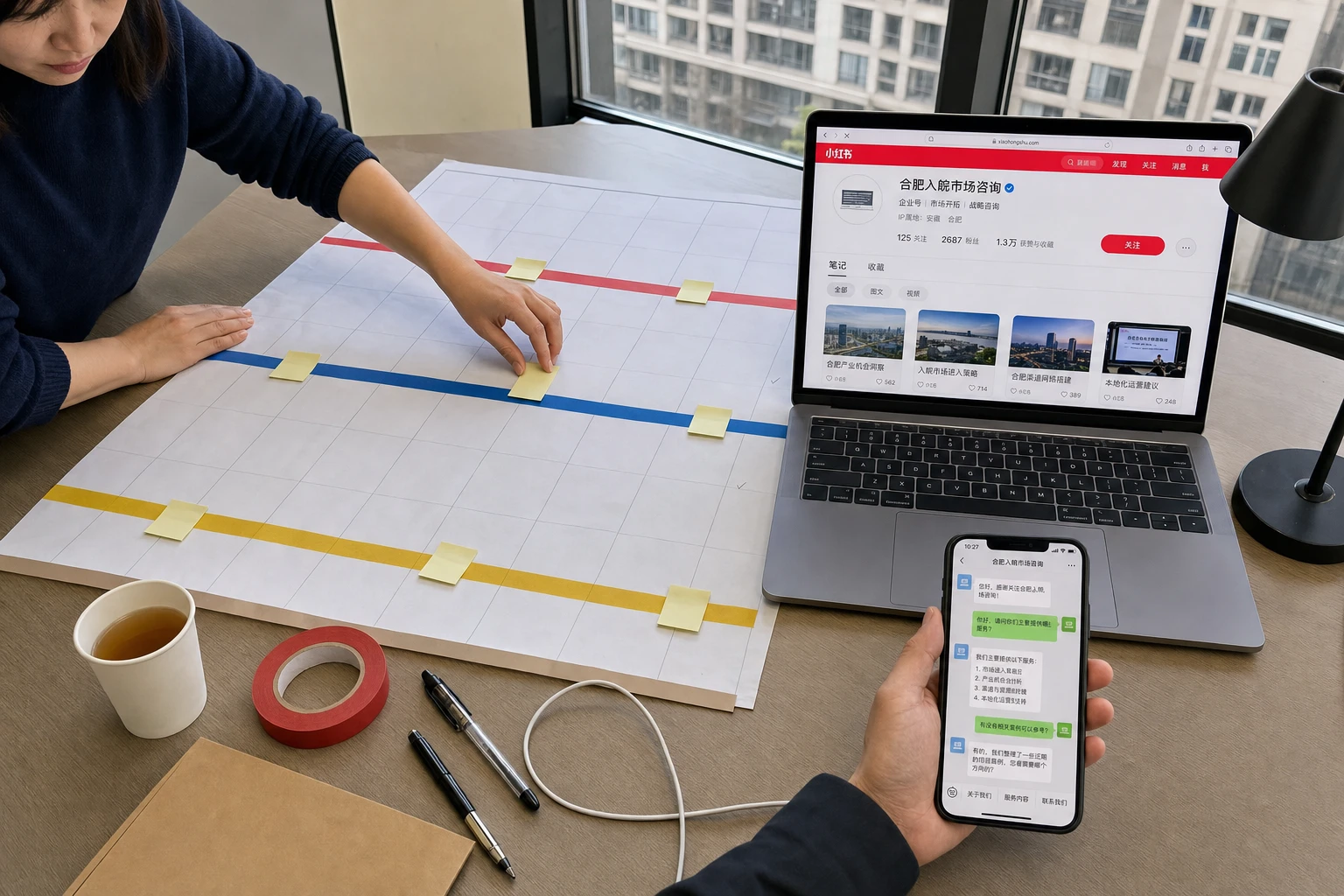
Six months is a realistic China market entry timeline for a social-first launch. The accounts are not the slow part. The trademark is, so it starts the day the board says yes.
It’s tempting to draw a China market entry timeline with “open accounts” in month one and “launch” in month two. The accounts part is right. Tencent reviews an overseas company’s WeChat (微信) file in 7 to 15 working days. What that plan leaves out is the name.
China’s trademark office, CNIPA (国家知识产权局), takes about four months just to examine a filing. Putting your brand name on a verified account, and later on your ads, depends on that filing. So the real plan runs three tracks side by side, and the legal one sets the date.
| Month | Track 1: legal and trademark | Track 2: accounts | Track 3: localization and content |
|---|---|---|---|
| 0 | Name search, filings in English and Chinese | Documents gathered, region checked | Chinese name chosen |
| 1 | Examination running | WeChat and Xiaohongshu filed | Profiles and pillars drafted |
| 2 | Examination running | Accounts verified on company name | First content built |
| 3 | Examination running | Ad account invitation requested | A month of content banked |
| 4 | Examination ends on average | Full calendar live | Soft launch |
| 5 | Publication and opposition window | Paid tests, first seeding | Content adjusted to search data |
| 6 | Registration still pending in most cases | Board read-out | Second content cycle |
Every wait below comes from a regulator or a platform, and each one is cited where it appears. All sources were checked twice in October 2026, and the plan assumes a board decision in month 0.
The three tracks behind a China market entry timeline
A China launch on social is three projects with different clocks.
The legal track runs on statute and moves slowly, in months, with deadlines written into the Trademark Law. Accounts move in working days, as long as the paperwork is exactly what each platform asks for (and each one asks for something slightly different). Localization is the track your own team controls, which is why it’s usually the one that slips.
But they’re linked. An account can go live in weeks on your registered company name. Putting the brand name on it, and running ads under it, waits on the trademark.
That’s why the trademark moves first, even though nothing public happens on it for months.
To track all three, our China social media readiness checklist lists each document and sign-off as one line to tick.
Track 1: legal and trademark, months 0 to 4
It needs a name search and a filing plan. It also needs a Chinese name, and foreign companies can’t file alone.
A foreign person or foreign company applying to register a trademark in China must go through a lawfully established trademark agency. Source: China National Intellectual Property Administration (国家知识产权局), Trademark Law, 2019 amendment, July 2019. https://www.cnipa.gov.cn/art/2019/7/30/art_95_28179.html
China registers the first filer, not the first user. Under the law, when two companies file similar marks for similar goods, the earlier filing wins.
Squatters know it.
China struck down more than 200,000 bad-faith trademark filings in the first half of 2023, and again in the first half of 2024. Source: China National Intellectual Property Administration (国家知识产权局), reposting Xinhua (新华网), July 2026. https://www.cnipa.gov.cn/art/2026/7/2/art_55_207044.html
Then the clock. The law gives the office nine months to examine, and it has been running well under that.
China’s average trademark examination period held steady at four months. Source: People’s Daily (人民日报), report on the State Council Information Office press conference, July 2026. https://paper.people.com.cn/rmrb/pc/content/202607/30/content_30171963.html
Four months is examination only. Publication and an opposition window follow. Today the window is three months, and the revised law cuts it to two.
The revised law gives opponents two months from publication and keeps the nine-month examination limit. It refuses filings made with no intent to use that clearly exceed normal business needs. It takes effect January 1, 2027. Source: China National Intellectual Property Administration (国家知识产权局), Trademark Law, 2026 revision, June 2026. https://www.cnipa.gov.cn/art/2026/6/26/art_95_206942.html
Which window applies depends on the publication date. On the four-month average, a mark filed in October 2026 would be published early in 2027. CNIPA’s draft transition rules would give it the shorter window.
Under the draft, marks published before January 1, 2027 keep the old three-month opposition period, and later ones follow the revised law. The draft is open for comment until November 12. Source: China National Intellectual Property Administration (国家知识产权局), draft transition measures for the revised Trademark Law, September 2026. https://www.cnipa.gov.cn/art/2026/9/28/art_75_208337.html
The whole track, step by step:
| Step | Time limit in law | What it takes in practice |
|---|---|---|
| Filing through an agency | No limit | Days, once the name is cleared |
| Examination | 9 months | About 4 months on average |
| Publication and opposition | 3 months, 2 if published from 2027 | Fixed |
| Registration, no opposition | After the window closes | About 7 months in a typical case (2023) |
| Refusal review, if refused | Request within 15 days, decision in 9 months | About 7 months (2023) |
| Opposition, if filed | Decision within 12 months | About 10 months (2023) |
In 2023, a typical registration took seven months. Oppositions averaged 10 months, and refusal reviews seven. Source: China National Intellectual Property Administration Trademark Office (国家知识产权局商标局), 2023 work results, January 2024. https://sbj.cnipa.gov.cn/gzdt/2026/0828/50967.html
The 2023 figures are the latest CNIPA has published for those steps.
Some brands extend an existing international registration to China through the Madrid system instead. That route has its own clock.
When China is designated through the Madrid system, the office has 18 months to refuse if the home office is party to the Protocol only. The limit is 12 months if it is party to both the Agreement and the Protocol. Source: China National Intellectual Property Administration Trademark Office (国家知识产权局商标局), Madrid FAQ, October 2022. https://sbj.cnipa.gov.cn/gjzn/2026/0830/53720.html
So what does the trademark actually hold up? Each platform gives a different answer.
Naming a verified WeChat account after a trademark requires an R mark registered with China’s trademark office. Marks registered abroad cannot be used. A mark still under application can only go through the platform’s self-chosen naming route. Source: Tencent customer service (腾讯客服), WeChat verification trademark naming rules, platform documentation, confirmed October 2026. https://kf.qq.com/touch/sappfaq/150722EVNrui150722zUVVNR.html
A foreign trademark on a Douyin enterprise account needs a Chinese registration certificate or a Madrid registration certificate. Source: Douyin Enterprise Account Help Center (抖音企业号帮助中心), verification information rules, July 2024. https://renzheng.douyin.com/support/content/141500?graphId=412&mappingType=2&spaceId=77
Xiaohongshu (小红书) is more flexible. Its verification rules, quoted in the next section, accept a trademark certificate or an acceptance notice that meets platform requirements. A foreign mark can use its foreign registration certificate. Its ad platform, Juguang (聚光), wants the filing to be at least three months old.
On Xiaohongshu’s Juguang ad platform, a mark still under application needs the acceptance notice. The application must be at least three months past its acceptance date. Source: Xiaohongshu (小红书), Juguang registration and account opening guide, May 2022. https://fe-video-qc.xhscdn.com/fe-platform/cc8a5f81ddb6d91d6be9dfb34e62b49b999f234b/%E8%81%9A%E5%85%89%E5%B9%B3%E5%8F%B0%E6%B3%A8%E5%86%8C%E4%B8%8E%E5%BC%80%E6%88%B7%E6%B5%81%E7%A8%8B.pdf
So if the ad account carries the brand name, timing matters. A filing made in month 0 passes the three-month mark in month 3. Wait until month 2 to file and the first branded ads can’t run before month 5.
Track 2: platform accounts and verification, months 1 to 3
The accounts are quick once the papers are right.
WeChat (微信) is the most predictable.
An overseas company’s WeChat verification is reviewed within 7 to 15 working days of a complete file. The fee is 99 US dollars per application, charged whether or not it passes. Source: Tencent customer service (腾讯客服), overseas entity verification FAQ, platform documentation, confirmed October 2026. https://kf.qq.com/faq/190723aQvMR31907233IF7FV.html
An overseas entity can register one WeChat Official Account, and only as a service account. It can be used once verification succeeds. Source: Tencent customer service (腾讯客服), overseas entity service account registration, platform documentation, confirmed October 2026. https://kf.qq.com/faq/180312zQjeYV180312FNNbmA.html
Xiaohongshu (小红书) updated its verification rules in October 2026. Check your home country before you plan around them.
Xiaohongshu verifies overseas companies according to the regions and industries it has opened. Its rules list mainland China, Hong Kong, Singapore, and Malaysia as opened regions. Review generally takes three working days, longer for complex files, extra documents, or holidays. Source: Xiaohongshu Juguang help center (小红书聚光帮助中心), enterprise professional account verification rules, updated October 2026. https://ad.xiaohongshu.com/next_help/docs/195c5fe505c71b4b0335a2fe0d61d8e0
Xiaohongshu enterprise verification costs 600 yuan per application, and each verification order expires after 30 days. Overseas companies apply on the desktop site. Source: Xiaohongshu (小红书), enterprise account verification guide, platform document, confirmed October 2026. https://fe-video-qc.xhscdn.com/picasso-editor/7072d509ee7370545a056b6f9030a926e8879dca.pdf
A company registered in another country should confirm its region is open before the plan is set. If your group owns a Hong Kong company, that company is in a named region. Settle which entity applies in month 0, not month 2.
Douyin (抖音) has its own route now.
Douyin’s enterprise help center lists a self-service onboarding guide for Hong Kong, Macau, Taiwan, and overseas companies, updated October 13, 2026. Source: Douyin Enterprise Account Help Center (抖音企业号帮助中心), October 2026. https://renzheng.douyin.com/support/content/227771?graphId=412&mappingType=2&spaceId=77
Its documents and fee sit behind a login. The service agreement does say when review starts.
Douyin starts reviewing an enterprise verification within 15 working days of a complete submission. Source: Douyin Enterprise Account Help Center (抖音企业号帮助中心), enterprise verification service agreement, January 2026. https://renzheng.douyin.com/support/content/123631?graphId=412&mappingType=2&spaceId=77
Weibo (微博) is the odd one out. It works with overseas companies through an overseas agent.
Weibo directs overseas enterprise accounts to the overseas agent that served them at verification. Source: Sina Weibo customer service (新浪微博客服), enterprise entity change rules, platform documentation, confirmed October 2026. https://kefu.weibo.com/faqdetail?id=21369
Our own published timelines sit inside these limits.
Most clients go from signed contract to a live, publishing WeChat account in about four weeks. Source: TheRedScroll, WeChat platform page, confirmed October 2026. https://www.theredscroll.com/platforms/wechat/
China Market Entry: live in 30 days, with accounts verified and first content published. Source: TheRedScroll, China Market Entry service page, confirmed October 2026. https://www.theredscroll.com/services/market-entry/
Those are planning figures, not measured averages, and they rest on the platform clocks above.
Track 3: brand localization and content, months 1 to 4
Nobody outside your company sets this clock.
It starts with the Chinese name, which has to exist in month 0 because the trademark filing needs it. Our advice is to file the Chinese name as its own mark alongside the Latin one. In our experience, choosing it is the step most likely to stall. The law does not require it, but first-to-file applies to Chinese names too.
Then come the profiles, the content pillars, and the first month of posts. Our first 90 days guide covers that work week by week. One rule matters most here. Build a month of content before the soft launch, so the calendar doesn’t stall once it starts.
Some categories add a regulator to this track.
An ordinary cosmetic is filed once the documents are submitted. A special cosmetic needs registration, with a 90-working-day technical review that restarts when extra documents are requested. Source: State Administration for Market Regulation (国家市场监督管理总局), cosmetics registration and filing measures, Order 35, January 2021. https://www.gov.cn/zhengce/zhengceku/2021-01/12/content_5579239.htm
An overseas cosmetics registrant or filer must appoint a legal entity inside China to handle registration and filing. Source: State Council (国务院), Cosmetics Supervision and Administration Regulation, June 2020. https://www.gov.cn/zhengce/content/2020-06/29/content_5522593.htm
Food, supplements, and medical devices have their own rules. If you sell one of those, the regulator, not the platform, can set your launch date.
That’s the setup. Months 4 to 6 are where the plan meets the public.
Month 4: the soft launch, and what it has to prove
By month 4 the accounts are verified, a month of content is banked, and the trademark examination is ending. The soft launch is the full calendar going live without paid support.
What should it prove? First, that the content pillars earn saves and comments, not just views. Then that some notes pull readers from search rather than only from the feed, which is the sign an account has started to compound. And messages from the profile should reach a named person and get an answer the same day.
No platform publishes a benchmark for a brand account in its fourth month. Judge the soft launch against its own first weeks.
Month 5: paid testing and the first creator seeding
Paid tests go behind the notes that already earned search traffic. Seeding starts with small creators who post about the product in their own words, booked through the creator marketplace of Xiaohongshu (小红书), Pugongying (蒲公英).
One catch for an overseas company: the ad account on Juguang (聚光), Xiaohongshu’s ad platform, is not self-serve.
On Xiaohongshu’s Juguang ad platform, every industry is by invitation for overseas companies, with no self-service entry. Applicants go through the platform’s sales or operations team. Qualification review is expected to take 48 hours. Source: Xiaohongshu Juguang help center (小红书聚光帮助中心), cross-border business admission rules, updated February 2026. https://ad.xiaohongshu.com/next_help/docs/27223a333b21567c31a8c7c8a60fbddb
So the invitation request goes in during month 3, while the content bank is still being built. We bill ad spend at cost, with no markup, and our pricing page lists what the work around it costs.
Month 6: what a realistic result looks like
Month 6 is too early to judge return on seeding. The marketing chief of Xiaohongshu (小红书) has given examples of how long payback takes.
Xiaohongshu’s chief marketing officer said a robot vacuum brand’s seeding return turned at about 45 to 60 days. Buyers of a body oil the brand thought was a seven-day decision often took 60 to 90 days. Source: Huxiu (虎嗅), via Sina (新浪), report on Xiaohongshu’s WILL conference, December 2024. https://finance.sina.com.cn/wm/2024-12-20/doc-ineacsym5596846.shtml
On those cycles, seeding that starts in month 5 may only pay back in month 7 or 8. A realistic month 6 shows verified accounts and a steady calendar. It shows search traffic on the best notes, a cost per read from the paid test, and the first inbound leads. In a typical case it won’t yet show a registered trademark either.
The five things that most often push the date
An incomplete file. The 7 to 15 working days on WeChat (微信) only start when the file is complete. A verification order on Xiaohongshu (小红书) lapses after 30 days. One missing letter, and the wait starts over.
A name conflict. A refusal gives you 15 days to ask for a review, and reviews averaged seven months in 2023. An opposition averaged ten. If a squatter already holds your name on WeChat, there is a complaint route.
A trademark holder can complain about an account using its name. WeChat reviews the complaint within seven working days, the other side has seven days to appeal, and the name is released if the appeal fails. Source: Tencent customer service (腾讯客服), WeChat Official Account infringement complaints, platform documentation, confirmed October 2026. https://kf.qq.com/faq/120911VrYVrA161026ammAjA.html
A regulated category. Cosmetics, food, and supplements can add months that no agency can shorten.
Platform access. Xiaohongshu’s open regions and Juguang’s invitation step both decide who can apply, not just how fast.
Then there’s the calendar, China’s and your own. Reviews run in working days, and China’s long holidays stop them.
In 2026, China’s Spring Festival holiday ran nine days, February 15 to 23, and National Day ran seven, October 1 to 7. Source: State Council General Office (国务院办公厅), 2026 public holiday notice, November 2025. https://www.gov.cn/zhengce/content/202511/content_7047090.htm
Your own calendar does as much damage. A naming decision that sits with a global brand team for six weeks moves every track by six weeks.
What to tell your board
A board paper needs dates and a way to tell each one is met. This is the milestone table we’d put in it.
| Milestone | Target month | Evidence it’s done |
|---|---|---|
| Name cleared and marks filed | 0 | CNIPA acceptance notices for both names |
| Accounts verified | 1 to 2 | Verification badges on WeChat and Xiaohongshu |
| Content bank ready | 3 | A month of approved posts |
| Ad account invited | 3 to 4 | Juguang qualification approved |
| Soft launch | 4 | Full calendar live, replies within a day |
| Paid test and seeding | 5 | Cost per read, first creator notes |
| Board read-out | 6 | Search share, leads, test results |
| Trademark registered | About 7 | Registration certificate |
Three sentences belong in the cover note. The accounts are fast and the trademark is slow, so the trademark goes first. Month 6 shows signals, not return. And the dates hold only if the documents and the Chinese name are ready in month 0.
For the entity question that comes up in the same meeting, our guide on whether you need a Chinese entity goes platform by platform.
Frequently asked questions
How long does China market entry take?
For a social-first launch, plan on about six months from board approval to a running launch with paid tests and the first leads. The accounts can be verified in the first month or two. The trademark is slower: examination averages four months, then an opposition window, and a typical registration took seven months in 2023. Regulated categories can add more.
Do I need a trademark before launching in China?
Not to open accounts. They can launch on your registered company name. You need a filing to use the brand name well. Tencent’s naming rules let a verified WeChat (微信) account carry a trademark only once it’s registered in China, and Douyin (抖音) wants a registration certificate. Xiaohongshu (小红书) ads accept a pending mark three months after acceptance. File in month 0.
What can go wrong with a China launch timeline?
Five things, mostly. An incomplete document file. A name conflict or a squatter. A regulated product category. Platform access rules, such as the open regions on Xiaohongshu (小红书). And the calendar, from Spring Festival to slow headquarters approvals. Most of these are settled, or not, in month 0.
Book a call
If you’re putting a China plan in front of your board, book a call. We’ll lay these three tracks over your own documents and category, and tell you which month your brand name can go on each account. Our China Market Entry service page explains how we run the launch with you.
Want to grow your brand on China's social platforms?
Book a call