Strategy
Do you need a Chinese entity to run social media in China?
Usually not, at least to start. Three of the four platforms that matter can verify a company registered outside the mainland. Two of them publish the rules plainly. The third routes you through an agent.
This is the question that stops the first sales call. The answers online contradict each other, and a lot of them are simply out of date: Xiaohongshu changed how overseas advertisers get access in February 2026 alone. So here is the short version, per platform, checked against what each one publishes.
| Platform | What the platform publishes | What you file | Verification fee |
|---|---|---|---|
| WeChat (微信) | Overseas entities accepted, one account | Registration certificate, chopped letters | 99 US dollars a year |
| Xiaohongshu (小红书) | Overseas entities accepted by name | BR or CR, stamped Chinese translation | 600 yuan a year |
| Weibo (微博) | Overseas entities go through an agent | Not the self-serve form | 600 yuan |
| Douyin (抖音) | No rule either way | A mainland business license | 600 yuan first year |
Two caveats before the detail. An account is not the same thing as everything an account can do, and advertising is where that shows. Second, this is rarely a yes or no question at all. It is a question about timing, because almost nothing in your first six months needs a mainland company.
This article is general information, not legal advice. Entity structure, tax and import rules turn on facts about your own business, and a China qualified lawyer should see them before you commit.
Every source below was checked twice in September 2026.
What an overseas entity can do on WeChat
WeChat (微信) is the clearest case. Tencent runs a separate registration and verification track for companies registered outside the mainland, documents it in Chinese and English, and prices it in US dollars.
An overseas entity may register one WeChat Official Account. Overseas regions support the service account type only, and the account can be used normally only after verification. Source: Tencent customer service (腾讯客服), overseas entity registration guide, platform documentation, confirmed September 2026. https://kf.qq.com/faq/180312zQjeYV180312FNNbmA.html
Two limits hide in that one sentence. One account, not a portfolio. And a service account, which behaves differently from the subscription accounts most foreign marketers have seen screenshots of.
The paperwork is ordinary corporate paperwork.
Verification for an overseas entity requires the company registration certificate or business license, a color scan of the contact person’s ID, an application letter, an operation authorization letter, a phone bill or stamped bank statement, and a trademark registration or authorization if the account is named after a mark. Source: Tencent customer service (腾讯客服), overseas entity verification materials, platform documentation, confirmed September 2026. https://kf.qq.com/faq/190723Mjey67190723ey6Fbi.html
The fee is 99 US dollars, and it is charged whether or not you pass.
Verification of an overseas entity completes within 7 to 15 working days after complete documents are submitted, at 99 US dollars per application, charged regardless of the outcome. Source: Tencent customer service (腾讯客服), overseas entity verification FAQ, platform documentation, confirmed September 2026. https://kf.qq.com/faq/190723aQvMR31907233IF7FV.html
Put the mainland numbers next to that and the real gap shows.
Verification review for a mainland entity takes 1 to 3 working days, and the verification fee is 300 yuan per application, valid one year. Source: Tencent customer service (腾讯客服), verification review time and verification fee FAQs, platform documentation, confirmed September 2026. https://kf.qq.com/faq/120911VrYVrA1312123qyyqI.html
So the penalty for staying offshore on WeChat comes to about two weeks instead of about two days, one account instead of several, and a fee in dollars instead of yuan. Annoying, and survivable.
What an overseas entity can do on Xiaohongshu
Xiaohongshu (小红书), which the site also calls RedNote, admits overseas companies by name. Its enterprise verification guide lists mainland, overseas and Hong Kong, Macau and Taiwan companies as eligible in the same breath.
Enterprise account verification is open to mainland, overseas and Hong Kong, Macau and Taiwan companies. The fee is 600 yuan per application, valid one year, with an annual review. Overseas entities complete verification, annual reviews and renames on the desktop site only. Source: Xiaohongshu (小红书), enterprise account verification guide, platform documentation, confirmed September 2026. https://fe-video-qc.xhscdn.com/picasso-editor/7072d509ee7370545a056b6f9030a926e8879dca.pdf
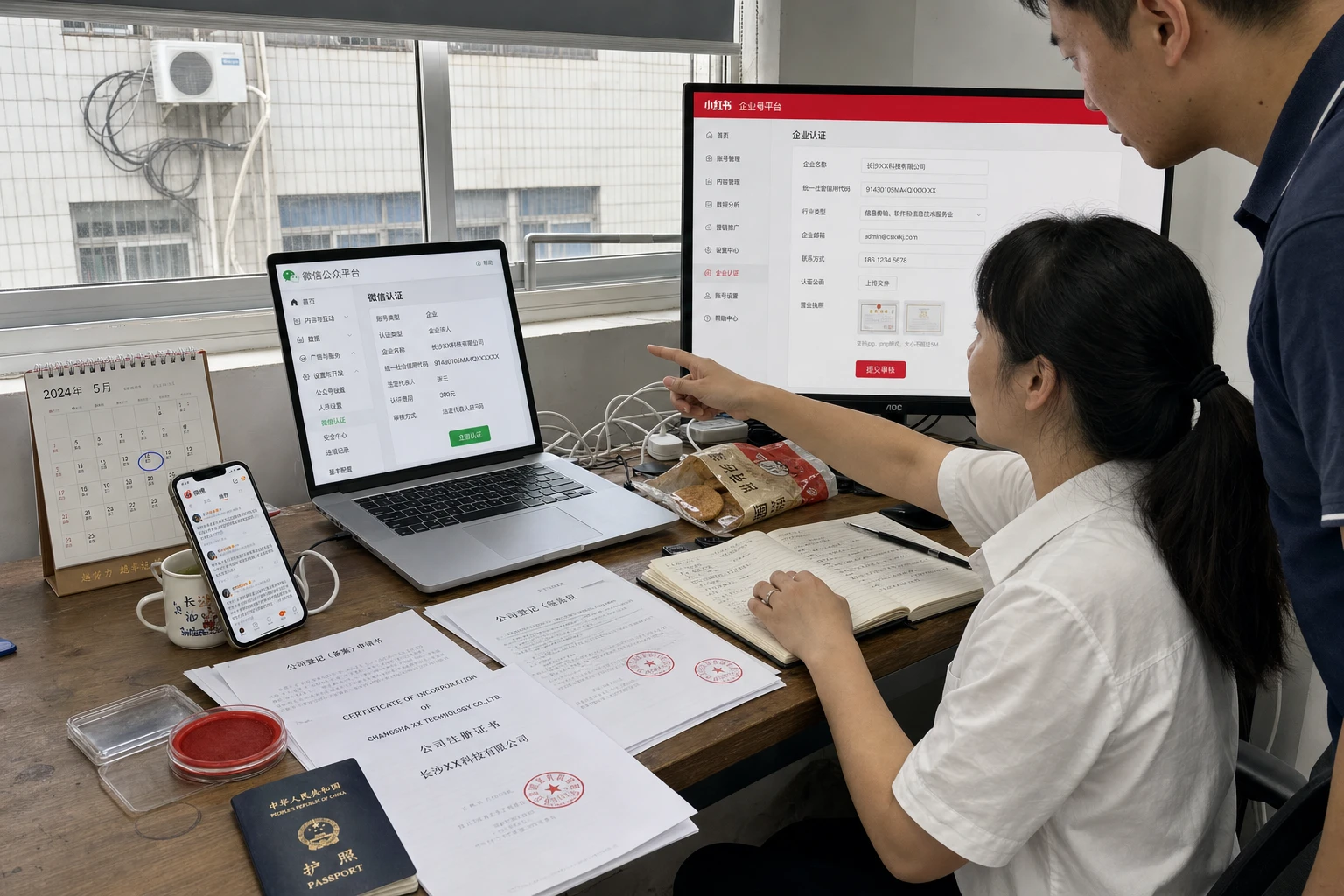
Overseas companies file a Business Registration or a Certificate of Incorporation instead of a mainland license, and Hong Kong companies file both. Documents in a language other than Chinese need a translation carrying a translation company’s stamp. Our step-by-step Xiaohongshu business account setup guide walks through the screens and the rejection reasons in detail.
Review time is published, which is rare.
After an enterprise application is submitted, a review specialist makes contact within 1 working day, and review completes in 4 to 7 working days on average. A single review order is valid for 30 days. Source: Xiaohongshu (小红书), professional account product guide, platform documentation, confirmed September 2026. https://fe-video-qc.xhscdn.com/fe-platform/68e374e4257bd30bc07eed15c06cb8b9a51f971b.pdf
Then the gap opens. You can hold the account offshore. Buying ads against it is a different matter, and since early 2026 the self-serve door has been closed. The platform has not published this change itself, so the citation below is a specialist trade guide rather than platform documentation, and it is the weakest source on this page. Treat it as a reason to ask your agency what access it actually has, not as the final word.
Since February 2, 2026, overseas merchants are admitted to the Jiguang ad platform through an authorized agent only, with no self-serve account opening. Source: Ziyouxing Studio (自由行Studio), Xiaohongshu Jiguang overseas guide, August 2026. https://zyxstudio.net/articles/xiaohongshu-jiguang-guide.html
The same split runs through every platform on this page. Organic publishing is open to you. Paid distribution is where a mainland footprint, yours or somebody else’s, starts to matter.
Side by side, on the two platforms that publish the most, the offshore penalty is smaller than most agencies imply.
| Mainland entity | Overseas entity | |
|---|---|---|
| WeChat accounts | Several account types | One, service account only |
| WeChat review | 1 to 3 working days | 7 to 15 working days |
| WeChat fee | 300 yuan a year | 99 US dollars a year |
| Xiaohongshu filing | Business license | BR or CR, stamped translation |
| Xiaohongshu where you apply | App or desktop | Desktop only |
| Xiaohongshu ads | Self-serve | Through an authorized agent |
None of those rows stops a launch. They cost you a couple of weeks on WeChat and a phone call on Xiaohongshu ads, which is a very different thing from needing a company.
Douyin and Weibo: where it gets harder
These two are where the confident blog posts get it wrong, in opposite directions.
Douyin (抖音) does not publish a rule for overseas entities at all. What it publishes is a description, and a document list that assumes a mainland license.
The platform’s FAQ describes the Douyin enterprise account as an account for companies in the China region. Source: Ocean Engine (巨量引擎), Douyin enterprise account FAQ, May 2022. https://www.oceanengine.com/faq/douyin-qyh-kslj.html
Douyin enterprise verification requires a business license and an application letter, costs 600 yuan for the first year and 120 yuan a year to renew, and completes qualification review about 2 working days after submission. Source: Ocean Engine (巨量引擎), Douyin enterprise verification FAQ, May 2022. https://www.oceanengine.com/faq/douyin-qyh-zmrzn.html
That document list is the tell. No page on Ocean Engine says an overseas company may not apply. No page says it may, either. So treat Douyin as undocumented. Not closed, just unwritten. If Douyin is central to the plan, budget for a mainland entity and stop hunting for a rule that does not exist.
Weibo (微博) publishes plenty about verification, but the part foreign brands need is buried in a page about something else. Start with the form itself, which is built around a mainland company.
The enterprise verification rules accept nine license types, all of them mainland documents. The company name must match the business license, the registration number field takes the unified social credit code, and website claims require a screenshot of the MIIT filing. Only a physical color company chop is accepted, never an electronic one. Source: Sina Weibo customer service (新浪微博客服), enterprise verification review rules, platform documentation, confirmed September 2026. https://kefu.weibo.com/faqdetail?id=21546
A unified social credit code is issued to mainland registered companies. A foreign company does not have one, which tells you what the form expects. The fee is the same either way.
Enterprise blue V verification requires a one-time payment of 600 yuan per application as a review service fee, charged whether or not verification succeeds. Government, media, institution, campus and charity accounts are subsidized by the platform. Source: Sina Weibo customer service (新浪微博客服), verification fee FAQ, platform documentation, confirmed September 2026. https://kefu.weibo.com/faqdetail?id=20004
So how do foreign brands end up verified on Weibo? Through an agent. Weibo says so in the one place nobody reads, the rules for changing the entity behind an existing account.
Online self-service entity change covers domestic company to domestic company only. A change from an overseas or Hong Kong, Macau and Taiwan company to another overseas company runs offline, through the overseas agent that handled the original verification. Source: Sina Weibo customer service (新浪微博客服), entity change rules, platform documentation, confirmed September 2026. https://kefu.weibo.com/faqdetail?id=21369
There is a separate email route at Weibo, but it is not for ordinary companies. It covers institutions: fan clubs, sports bodies, museums, theaters, official game accounts. Non-mainland institutions send a Chinese language application form, chopped letters and their registration license to a verification mailbox rather than using the form. The page was updated on July 6, 2026.
| Douyin (抖音) | Weibo (微博) | |
|---|---|---|
| Overseas rule published | No | Only inside the entity-change rules |
| Route for a foreign brand | Undocumented | An authorized overseas agent |
| Fee | 600 yuan, then 120 a year | 600 yuan per application |
| Review | About 2 working days | 1 working day for an entity change |
| Accounts per license | Not stated | Several on one license |
Cross-border e-commerce as a route in
Selling changes the question. There is a third path here, and it steps around the entity problem entirely. Cross-border retail import lets an overseas company sell to Chinese consumers with no mainland registration at all, inside limits the finance ministry sets.
The single transaction limit for cross-border e-commerce retail imports rose from 2,000 yuan to 5,000 yuan, and the annual limit per consumer from 20,000 yuan to 26,000 yuan. Where a single item is priced above the 5,000 yuan transaction limit but below the annual limit, and the order holds that item alone, it may still come through the cross-border channel, with tariff, import VAT and consumption tax charged in full at the goods rate. Source: Ministry of Finance, General Administration of Customs and State Taxation Administration (财政部 海关总署 税务总局), notice 财关税〔2018〕49号, November 2018, effective January 1, 2019. https://fgk.chinatax.gov.cn/zcfgk/c102416/c5202372/content.html
One clause in that notice catches people out, and it is not about money.
Goods bought through cross-border e-commerce are final goods for the consumer’s personal use and may not be resold into the domestic market. Source: Ministry of Finance, General Administration of Customs and State Taxation Administration (财政部 海关总署 税务总局), notice 财关税〔2018〕49号, November 2018. https://fgk.chinatax.gov.cn/zcfgk/c102416/c5202372/content.html
Cross-border is a consumer channel, not a wholesale one. You cannot use it to stock a mainland distributor, and a customs authority that decides your shipments are really wholesale will treat them as general trade.
Those ceilings are per shopper, per year. They rarely bite a launch. The assumption underneath them does. The channel is built around one consumer buying for herself, which is why the limits sit where they do, and it fits skincare, supplements, small appliances and accessories comfortably. Price a single item above 5,000 yuan and it can still go through, but the duty and import taxes land in full, which usually kills the margin that made the channel attractive.
On Xiaohongshu the cross-border path has its own paperwork, and brand authorization is the part that takes longest.
Overseas companies, including Hong Kong, Macau and Taiwan, file a Business Registration and a Certificate of Incorporation. Cross-border trade requires an authorization letter from the brand owner for every brand, with a complete authorization chain, capped at three levels and two for beauty brands. Source: Xiaohongshu (小红书), merchant qualification requirements, platform documentation, confirmed September 2026. https://picasso-static.xiaohongshu.com/test/8b3bc7324ca06fceea379177f9eed1fa/%E5%B0%8F%E7%BA%A2%E4%B9%A6%E8%B5%84%E8%B4%A8%E5%85%A5%E9%A9%BB%E8%A6%81%E6%B1%82.pdf
If your China distributor holds the trademark rather than you, count the levels before you promise a launch date.
What setting up a Chinese company actually takes
Suppose you decide you do want one. Maybe Douyin matters, maybe you are hiring. Here is what the process actually involves, as opposed to what incorporation agents tend to describe.
The good news first, and it surprises most people. Since the foreign investment rules were rewritten, a foreign investor outside the restricted sectors registers a company on the same terms as a Chinese one.
Outside the negative list, foreign investment is administered on the same basis as domestic investment. A foreign investor may not, however, be a sole trader or the investor in a one-person enterprise. Source: National Development and Reform Commission and Ministry of Commerce (国家发展改革委 商务部), foreign investment access negative list, 2024 edition, order 23, September 2024, effective November 1, 2024. https://www.gov.cn/zhengce/202409/content_6973047.htm
The registration step itself is fast, free at the counter and, in Beijing at least, does not require anyone to show up.
Complete applications in the correct form are registered on the spot. Where that is not possible, registration follows within 3 working days, extendable by a further 3 with the registrar’s approval. Source: State Council (国务院), Regulations on the Registration and Administration of Market Entities, order 746, effective March 1, 2022, Article 19. https://www.gov.cn/gongbao/content/2021/content_5636139.htm
Beijing goes further than the national floor.
Beijing lists company setup registration as a same-day item, with a statutory limit of 6 working days, a committed processing time of 0 working days and 0 required visits to a service counter. Source: Beijing municipal government services (北京市政务服务), company establishment registration guide, guide version January 2026. https://banshi.beijing.gov.cn/pubtask/task/1/110000000000/e71f13ba-9a0c-4cf4-983a-88b63ae94337.html
So why does everyone say it takes months? Because the slow part happens before any of that, in your own country.
The foreign investor’s subject qualification certificate must be notarized by a notary in its home country and then legalized by the Chinese embassy or consulate there. Where there are no diplomatic relations, legalization runs through a third country. Foreign language documents need a translation bearing a translation company’s chop and a copy of that company’s license. Source: Qianhai Authority, Shenzhen (深圳市前海管理局), foreign-invested enterprise establishment process, September 2025. https://qh.sz.gov.cn/tzqh/tzzn1/wzzr/content/post_10551249.html
Notarization and consular legalization are the long pole. They are also the part no consultant controls, which is why quoted timelines vary so much.
On total cost, this article gives you no number, on purpose.
Every figure we found traces back to an incorporation agent quoting its own service fee. Not one is a dated professional source, so we are not going to print a range we cannot stand behind. What we can give you is the shape of the bill. The government registration step carries no fee at all. The variable costs are notarization, consular legalization, translation, a registered address and professional fees. Ask for those five quoted separately and padding becomes very easy to see.
This is also the point in the process where the legal advice caveat earns its keep. Entity type, scope of business and tax residency all turn on facts about your own company, and they are expensive to change later. Our China market entry service covers the social and commercial side of the move, and our pricing page lists what we charge for the work we do.
The middle path: an agency-held account, and its risks
The common workaround is to have a Chinese agency register and verify the account on its own license while the brand runs it. It works. It is also the single most expensive mistake in this article, and the reason sits in a contract clause almost nobody opens.
Ownership of a WeChat Official Account rests with Tencent. The right to use it goes to the entity that first registered it, and where the entity submitted at verification differs from that registrant, the right to use the account passes to the entity that passed the qualification review. Gifting, lending, renting, transferring and selling the right to use an account are prohibited. Source: Tencent (腾讯), WeChat Official Account Platform service agreement, clause 6.1, confirmed September 2026. https://mp.weixin.qq.com/cgi-bin/readtemplate?lang=zh_CN&t=home%2Fagreement_tmpl&token=&type=info
Take the middle clause slowly. If the agency’s license went through verification, the right to use that account is the agency’s under the agreement you both accepted. Not yours. Your logo is on it, your budget built the following, and the platform recognizes someone else.
Then the exit gets worse, because the obvious fix is contractually barred. You cannot simply be handed the account, since transferring the right to use one is prohibited outright. And the platform reserves the right to act on its own.
Where Tencent finds that the holder is not the entity that first registered the account, it may terminate that party’s use of the account without notice. Source: Tencent (腾讯), WeChat Official Account Platform service agreement, clause 6.3, confirmed September 2026. https://mp.weixin.qq.com/cgi-bin/readtemplate?lang=zh_CN&t=home%2Fagreement_tmpl&token=&type=info
Weibo writes the same rule in fewer words.
Users may not sell, transfer or rent any Weibo account or Weibo nickname without the consent of the Weibo operator. Source: Sina (新浪), Weibo Terms of Use, clause 1.2.2, confirmed September 2026. https://weibo.com/signup/v5/protocol
And Weibo adds a lock of its own for foreign brands. Remember that entity change for an overseas company runs offline through the overseas agent that handled the original verification. The agency that verified your account is in the room for any attempt to move it. Xiaohongshu closes a smaller door the same way: the applying entity cannot be changed once a review has started.
None of this makes an agency-held account wrong. It is often the right call for a pilot, and it is how a lot of well-run foreign brands got started. It does mean three questions belong in the contract before the first post:
- Which legal entity is named on the verification, in writing?
- What happens to the account, the followers and the content if we leave, and who signs what?
- Who holds the admin credentials, the bound phone number and the chop used on the application?
An agency that cannot answer all three in writing is telling you something.
Running social media in China without a Chinese entity
| If this is you | Where to begin | Entity needed |
|---|---|---|
| Testing demand, no revenue in China yet | WeChat service account plus Xiaohongshu, both on your own entity | No |
| Selling to consumers, no mainland stock | Cross-border retail import, inside the 5,000 and 26,000 yuan limits | No |
| Ready to buy Xiaohongshu ads | Your own account, ads through an authorized agent | No |
| Douyin is central to the plan | Budget for a mainland entity | Likely yes |
| Hiring locally, invoicing in yuan, holding stock | A mainland company | Yes |
| Offered an account on an agency’s license | Get the three contract answers first | No, but read clause 6.1 |
Read that table one way and it says something simple. Entity questions are timing questions. Most foreign brands should launch on their own entity, learn what the audience responds to, and register a mainland company when advertising, hiring or stock makes it pay for itself. Our guide to the first 90 days on Chinese social sets out what that launch actually looks like.
One caution on all of the above. Platform access rules move faster than company law does, and they move without announcements: the Xiaohongshu ad change in February 2026 is the recent example, and it never appeared in a press release. Everything here was verified against the source documents in September 2026. Check the current page before you file anything.
Common questions
Can a foreign company open a WeChat Official Account?
Yes. Tencent runs a documented registration and verification track for overseas entities. The limits are real, though: one account per overseas entity, service account type only, and the account works only once verification passes. Budget 99 US dollars and 7 to 15 working days, and expect the fee to be charged even if the application fails.
What is the difference between an overseas and a mainland account?
Mainly speed, scale and what you can buy. A mainland entity on WeChat is verified in 1 to 3 working days rather than 7 to 15. On Weibo the self-serve form expects a unified social credit code that only a mainland company has, and one mainland license can carry several enterprise accounts. Ad platforms are the sharpest difference, with overseas advertisers on Xiaohongshu routed through an authorized agent since February 2026.
Is an agency-held account safe?
It is workable, not safe by default. Under the WeChat agreement the right to use an account follows the entity that passed verification, and transferring that right is prohibited, so an account verified on your agency’s license is not straightforwardly yours to take. Fix it in the contract before launch, and name the verifying entity in writing.
Talk it through before you register anything
Most of the cost in this decision comes from doing it in the wrong order: registering a company you did not need yet, or launching on an account you cannot keep. A 30-minute call is usually enough to tell which one you are about to do.
Want to grow your brand on China's social platforms?
Book a call