Platforms
Xiaohongshu marketing for foreign brands: the complete 2026 guide
Xiaohongshu is where Chinese shoppers check before they buy. A foreign brand can verify an account with its own overseas paperwork. Ads and stores go through an agent.
Most guides to Xiaohongshu (小红书) marketing for foreign brands are written from the outside. This one is written from accounts we run for foreign clients: what the dashboard shows, what gets throttled, and what the first month looks like.
Start with the three facts that decide your plan. Xiaohongshu is a search engine with a feed attached. Its users skew young, female, urban, and about to spend money. And the account is the easy part for a foreign company; the ads and the store are where an agent comes in.
| Question | Short answer | Where it’s covered |
|---|---|---|
| Can we open an account from abroad? | Yes, an enterprise professional account with overseas documents | Account types, entity rules |
| Can we run ads from abroad? | Only through an authorized agent since February 2026 | Entity rules |
| What content gets reach? | Image notes and short video built for search, not for the feed | Content that works |
| Do we need influencers? | Small creators first, paid promotion later | KOC seeding versus paid |
| What does it cost? | Verification fee is public; the rest is content and people | What it costs |
Every figure below comes from the platform’s own numbers or a dated trade source, and the citation sits under it. Where a number doesn’t exist, the guide says so instead of guessing. All sources were checked in September 2026.
Xiaohongshu is a search engine first and a social network second
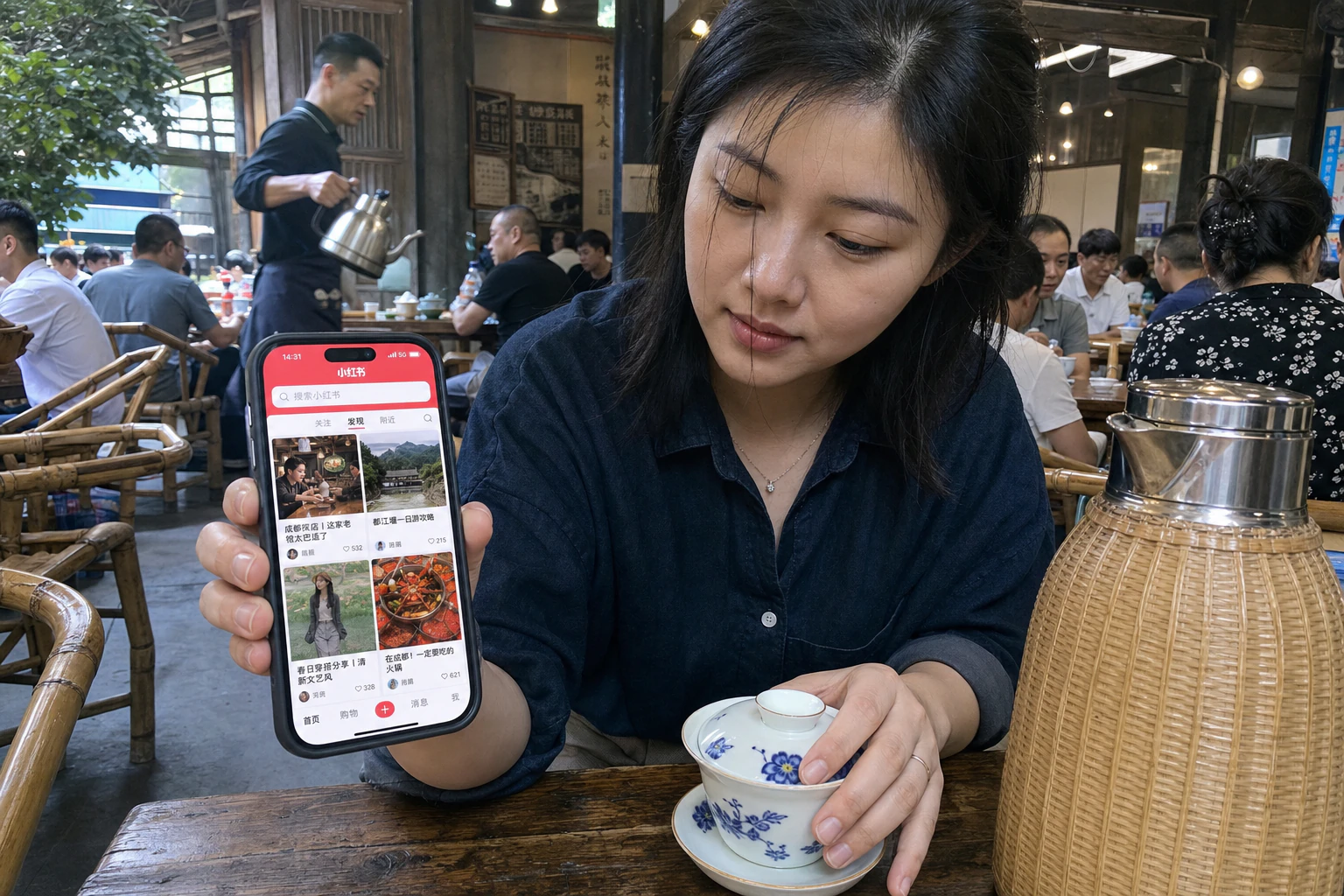
Xiaohongshu (小红书) was founded in 2013 as a shopping guide for Chinese travelers. Its English name on the app store is RedNote, and Western press still calls it Little Red Book. The product has not changed much: people post short “notes” (笔记) about things they bought, places they went, and problems they solved. Other people search for those notes before they spend.
That search habit is what makes the platform different from Douyin (抖音) or Weibo (微博). On Xiaohongshu, the search bar is the front door.
Xiaohongshu reported that its monthly active users passed 400 million and that daily searches reached 800 million. Source: Xiaohongshu (小红书) Video Creator Trend Report, reported by Beijing Business Today (北京商报) via Sina Finance (新浪财经), May 2026. https://finance.sina.com.cn/jjxw/2026-05-27/doc-inhziqxq9291575.shtml
Eighteen months earlier the count was smaller, and it was already being compared with Baidu (百度).
In the fourth quarter of 2024, Xiaohongshu handled about 600 million searches a day, up from 300 million in mid-2023. Source: Zhou Tian Finance (周天财经), reported by 199IT, December 2024. https://www.199it.com/archives/1731824.html
For a foreign brand this changes the job. On Douyin you compete for attention in a feed. On Xiaohongshu you compete to be the note a buyer finds when she types your product category, your competitor’s name, or a problem your product solves.
Who is on Xiaohongshu in 2026: young, female, urban, ready to spend
Who will read your notes? Xiaohongshu (小红书) answers that in the media brief it gives advertisers, and the trade press reprints it. The headline numbers from the 2025 brief are below.
The Xiaohongshu official brief describes 300 million monthly active users, a male to female ratio of 3 to 7, a 70 percent monthly search penetration rate, 50 percent of users born after 1995, 35 percent born after 2000, and 50 percent living in tier 1 and tier 2 cities. Source: Xiaohongshu (小红书) official brief, reported by Qian-gua Data (千瓜数据), April 2025. https://www.qian-gua.com/information/detail/3149
Seven in ten users are women. Half were born after 1995. Half live in the biggest cities. And seven in ten use the search bar in any given month. Of the six figures, that last one does the most work in your content plan.
A third-party count is lower, and it is worth knowing why.
QuestMobile measured Xiaohongshu at 242 million monthly active users in mainland China in May 2025, up 13.2 percent from a year earlier. Source: QuestMobile, reported by The Paper (澎湃新闻), November 2025. https://m.thepaper.cn/newsDetail_forward_31995524
The platform counts every account everywhere. QuestMobile counts a panel of mainland phones. Use the platform’s number for reach and the QuestMobile number when a finance director asks for an independent figure.
The intent data matters more than the size data. At its annual advertiser conference in December 2025 the platform put a number on how many people come to it for buying advice.
About 200 million users a month seek purchase advice on Xiaohongshu. Users open the app 16 times a day on average, and more than 9 million notes are published daily. Source: Xiaohongshu (小红书) 2026 WILL conference, data center figures for January to November 2025, reported by 100EC (网经社), December 2025. https://www.100ec.cn/detail--6655530.html
The platform hasn’t published what share of searches are product related. The closest official figure is the one above: 200 million people a month asking what to buy. That is the audience a foreign brand is writing for.
The three account types, and the one a foreign brand needs
Xiaohongshu splits accounts into non-professional and professional. Inside professional there are two tracks: personal and enterprise. That gives three types that matter to a brand.
| Account type | Who it’s for | Verified with | What it gets |
|---|---|---|---|
| Personal account | Individuals | Nothing | Posting, no business tools |
| Personal professional account | Creators, freelancers | A mainland ID | Creator tools, brand deals through Pugongying |
| Enterprise professional account (Blue V) | Companies, mainland or overseas | Business documents and a fee | Data dashboard, ads access, shop link, employee accounts |
The enterprise professional account is the only one a foreign company should run. It carries the Blue V (蓝V) badge, and it is the account type the platform’s own guide describes.
Xiaohongshu enterprise accounts are open to mainland Chinese companies, overseas companies, and companies from Hong Kong, Macau, and Taiwan. The verification fee is 600 yuan per application, valid for one year with an annual review. A failed review is not refunded, and each order expires after 30 days. Source: Xiaohongshu (小红书) enterprise account verification guide, platform document, confirmed September 2026; New Rank (新榜), October 2025. https://a.newrank.cn/trade/news/4199
The same guide has three details foreign teams miss. Overseas entities verify through the desktop site, not the app. Any document not in Chinese or English needs a translation stamped by a translation company. And the account name must match the store name if you later open a shop.
What the dashboard shows once you are verified: for each note, impressions, reads, likes, saves, comments, and shares, plus the split between traffic from search and traffic from the discover feed. That last split is the number we watch most. A note that earns most of its reads from search will keep earning them for months. A note that only got feed traffic is done in three days.
What a foreign brand can and cannot do without a Chinese entity
This is the section that decides budgets, so here is the plain version.
You can open and verify an enterprise account with your home-country registration documents. You can post notes, reply to comments, run a Pugongying (蒲公英) creator campaign, and read the full dashboard.
You cannot open a self-serve ad account from abroad.
Since February 2, 2026, overseas merchants gain access to Xiaohongshu’s Jiguang ad platform only through an authorized agent, with no self-serve account opening. Source: Ziyouxing Studio (自由行Studio), Xiaohongshu Jiguang overseas guide, August 2026. https://zyxstudio.net/articles/xiaohongshu-jiguang-guide.html
Jiguang (聚光) is the platform’s ad platform. An agent opens the account on your behalf, sets the first deposit (the platform publishes no minimum, the agent does), and usually runs the campaigns. That is where a China-based agency earns its place in your first year.
You can sell, but the store has its own paperwork. The merchant qualification rules treat overseas companies as a separate category.
Overseas companies, including those in Hong Kong, Macau, and Taiwan, apply with a business registration and certificate of incorporation. Cross-border stores need a complete brand authorization chain for each brand, or purchase proof for at least one product if no authorization exists. Imported cosmetics need the China import cosmetics filing. Source: Xiaohongshu (小红书) merchant qualification requirements, platform document, confirmed September 2026. https://picasso-static.xiaohongshu.com/test/8b3bc7324ca06fceea379177f9eed1fa/小红书资质入驻要求.pdf
The practical sequence for a pre-entry brand is the account first, creator seeding second, and a store only once search demand for the brand name shows up in the dashboard. Most of our clients spend three to six months in the first two stages before the third makes sense.
Content that works: the note formats that get distribution
Xiaohongshu has two native formats, image notes (图文笔记) and video notes (视频笔记). Both are vertical, both open with a cover, and both live or die on the first line of the title.
Here is what we see across client accounts. The notes that get distribution share five traits.
| Trait | What it looks like | Why it earns reach |
|---|---|---|
| Search-shaped title | A question or a category phrase, under 20 characters | Matches what users type |
| Cover with a text overlay | Product plus a four-character promise | Stops the scroll in a grid |
| Real use, not a studio | Hands, kitchens, bathroom shelves, office desks | Reads as a note from a friend |
| Comparison or list | “Three tried, one kept” | Gets saved, and saves drive ranking |
| Comment-ready ending | An open question, or a “which one for you?” | Comments extend the note’s life |
Two formats outperform on foreign brand accounts. The first is the honest comparison: your product against two others in the category, with a reason to choose each. Users save it, and saves are what the ranking rewards. The second is the how-to that happens to use your product. A skincare routine. A coffee recipe. A packing list for a Chengdu (成都) weekend.
Brand-voice posts, campaign visuals, and anything that looks like a print ad get throttled. Not banned. Throttled. The dashboard shows a few hundred impressions and then nothing. We have watched polished global creative from a client’s headquarters stall at that level, while a phone photo of the same product on a Guangzhou (广州) sidewalk kept collecting reads from search for months.
The platform’s own advertiser message points the same way. At its December 2025 conference it described zhongcao (种草), the practice of planting a desire through real notes, as entering an “effectiveness era.” The measure the platform now sells advertisers is the purchase a note leads to. Likes don’t come into it.
The search layer: how buyers find products through notes
Most guides skip this part. It is where a foreign account is won or lost.
A note can be found three ways: the discover feed, a follower’s feed, or search. For a foreign brand with a small following, search is the only one that scales.
How it works in practice. A user types a query. The results page mixes notes, products, and accounts. Notes rank on a blend of keyword match, engagement (saves and comments weigh more than likes), recency, and the account’s history in that topic. The platform does not publish the weights. What we see in client dashboards is that saves and comments move a note up faster than likes, and that a note on a topic the account has posted about before ranks sooner than a one-off.
The first job is to find out what your buyers type. The search bar’s autocomplete is the free tool: type your category and read the suggestions. Those are real queries, ranked by volume. Do it for your category, your competitor names, and the problems your product solves, and you have a title bank that will last a quarter.
Then write the query into the title, once, in natural Chinese. Not the English brand name alone. Chinese users search in Chinese, and a foreign brand with no Chinese name has no search presence.
Last, answer the query in the first three lines of the note and tag it. Tags (话题) are the platform’s own taxonomy. A note with three relevant tags and one good title beats a note with fifteen tags every time we’ve tested it.
A typical month on a new account shows the pattern. Week one, all traffic is feed traffic and it dies fast. By week four, if the titles are right, search becomes the largest source in the dashboard and the older notes keep collecting reads.
KOC seeding versus paid: which one to buy first
Xiaohongshu runs on other people’s notes about your product. There are two ways to get them: seed small creators, or pay for reach.
Key opinion consumers (KOC) are ordinary users with a few thousand followers. Key opinion leaders (KOL) are the bigger accounts. The fee gap between them is wide.
On Xiaohongshu, a nano KOC with 1,000 to 5,000 followers charges about 20 to 60 dollars per post, while a micro KOL with under a million followers charges about 10,000 to 35,000 dollars per campaign. Source: Long Advisory, June 2026. https://longadvisory.eu/en/kol-vs-koc-marketing-in-china-which-delivers-better-roi/
Whichever tier you use, paid creator work goes through the platform’s marketplace, Pugongying (蒲公英), and the platform takes a cut.
Beyond the creator’s fee, Xiaohongshu charges a content cooperation service fee on Pugongying deals: 10 percent in standard mode and 20 percent in the premium mode that adds platform promotion. Source: Niaoge Biji (鸟哥笔记), October 2022. https://www.niaogebiji.com/article-482538-1.html
Some agencies skip Pugongying to save the fee. We don’t, for a foreign brand. An unreported commercial note risks being flagged as an ad and losing reach. A reported note keeps its distribution and can be put behind paid promotion later, which is where the next stage of the plan needs it.
Seeding earns its keep at launch, when nobody has searched for your brand name yet and you need 20 to 40 real notes so a search for your category returns real people using your product. Paid comes after that. Once the dashboard shows which notes convert, Jiguang (聚光) budget behind those notes pushes them higher in the results for the queries that matter.
The mistake we see most is the reverse order. A brand pays for a big KOL post first, gets a spike, and then a buyer who searches the brand name finds one glossy post and nothing else.
Your first 90 days on Xiaohongshu, week by week
This is the plan we run for a pre-entry client, compressed. Ninety days is about how long it takes for search traffic to overtake feed traffic on a new account.
| Weeks | What happens | What you should see |
|---|---|---|
| 1 to 2 | Chinese brand name chosen, enterprise account verified on the desktop site, translated documents filed | Blue V badge, dashboard live |
| 3 to 4 | Title bank built from autocomplete, first 12 notes published, three a week | Feed traffic only, a few hundred impressions each |
| 5 to 8 | First 20 to 40 KOC notes seeded through Pugongying, comments answered daily | Brand name starts to appear in autocomplete |
| 9 to 12 | Best notes identified from the search split, Jiguang account opened through an agent, first paid push | Search overtakes feed as the top source |
Three notes on the table. The Chinese name comes first because everything else depends on it. Comments get answered daily because a reply counts as engagement on the note, and engagement is what keeps it in search. Paid comes last. It only works on notes that have already proved themselves.
Expect one throttled note in the first month, usually the one that looked most like an ad. Rewrite it as a comparison and post it again.
What Xiaohongshu marketing for foreign brands costs
Costs split four ways: platform fees, content, creators, and the people who run the account.
Platform fees are public and small. The enterprise verification is 600 yuan a year, quoted above. Pugongying (蒲公英) takes 10 or 20 percent of creator deals, also quoted above. Ad spend has a first deposit set by the agent who opens the Jiguang (聚光) account. Ask any agency to bill it to you at cost, with the platform’s own invoice attached.
Content is the largest line in the first three months. A dozen notes a month in Chinese, shot in a way that looks like a real person made them, is a production job. Creator seeding at the KOC tier is cheap per post and adds up by volume. The bigger KOL tier is a second-year decision for most of our clients.
Average KOL collaboration cost on Xiaohongshu runs 10,000 to 40,000 dollars, against 25,000 to 65,000 dollars on Douyin. Source: Long Advisory, May 2026. https://longadvisory.eu/en/how-much-influencers-cost-in-china-kol-pricing-explained/
The people cost is the one no rival guide prints. TheRedScroll publishes its full rate card on its pricing page, with fixed scope and ad spend billed separately with no markups. Our cost pillar, how much China social media marketing costs in 2026, walks through the five cost lines across platforms if you want the wider picture. For the platform itself, our RedNote agency page describes what a monthly Xiaohongshu engagement covers.
Our guide to how the Xiaohongshu algorithm ranks notes in 2026 covers the layer under everything in this guide. Before any of it, the account itself has to exist: Xiaohongshu business account setup, step by step has the documents, the Blue V fee, the naming rules and the timeline.
Frequently asked questions
Can a foreign company open a Xiaohongshu account without a Chinese entity?
Yes. The platform’s enterprise account guide accepts overseas companies and companies from Hong Kong, Macau, and Taiwan, using their home registration documents. Verification runs through the desktop site, costs 600 yuan a year, and needs stamped translations for documents not in Chinese or English. Ads and stores are the parts that need an agent or extra paperwork, not the account itself.
Is Xiaohongshu the same as RedNote?
Yes. RedNote is the English name the app adopted in its store listings, and Little Red Book is the literal translation of Xiaohongshu that Western press used for years. Chinese users say Xiaohongshu, and Chinese searches use the characters 小红书. Use Xiaohongshu in your planning and RedNote when talking to people who found the app through Western news coverage.
How long does Blue V verification take?
The platform does not publish a review time. Its guide gives each verification order a 30-day window and does not refund a failed review. In our experience, a mainland company with clean documents is verified within days. An overseas company usually takes two to three weeks, because stamped translations and the signed application letter take time to prepare and are the usual reason for a rejection.
Does Xiaohongshu work for B2B?
It can, in narrow cases. The audience is consumers, so a B2B brand wins only when the buyer is also a person who searches for advice: an architect looking at lighting, a small business owner choosing coffee equipment, a dentist comparing chairs. For those, search-shaped notes work the same way they do for consumer brands. For pure procurement, WeChat (微信) and Zhihu (知乎) are better homes.
Book a call
If you are planning a Xiaohongshu launch, book a call. We’ll look at your category’s search results together and tell you what a first 90 days would involve, before you spend anything on the platform.
Want to grow your brand on China's social platforms?
Book a call