Platforms
Private domain traffic in China: what WeCom groups actually return
Private domain traffic in China returns more frequent buying from customers you already have. In the company filings that break it out, it stays a small revenue line of its own.
Your brand has a WeCom account, a few hundred people in customer groups and a monthly report full of member counts. What it may not have is a clear line from those groups to sales. That gap is common, and it isn’t always your agency’s fault. The test that matters is simple: do group members reorder more often than customers outside the groups?
Begin with the three assets, and what each one costs and returns.
| Asset | What it does | Setup cost | What it returns |
|---|---|---|---|
| Official Account | Articles, four pushes a month | 99 dollars per verification, overseas entity | Reach to followers; the weakest tie |
| Customer groups | Up to 500 people per group | No platform fee; staff time | Repeat visits and offers; a middle tie |
| WeCom one-to-one contact | Staff add customers as contacts | 2,000 contacts free, then a yearly capacity fee | The strongest tie, at the highest cost |
Figures below come from WeCom’s and WeChat’s help pages, Chinese law and company filings, all checked on October 27, 2026. We found no public benchmark for group retention, and we say so where it matters.
What private domain traffic in China means, without the jargon
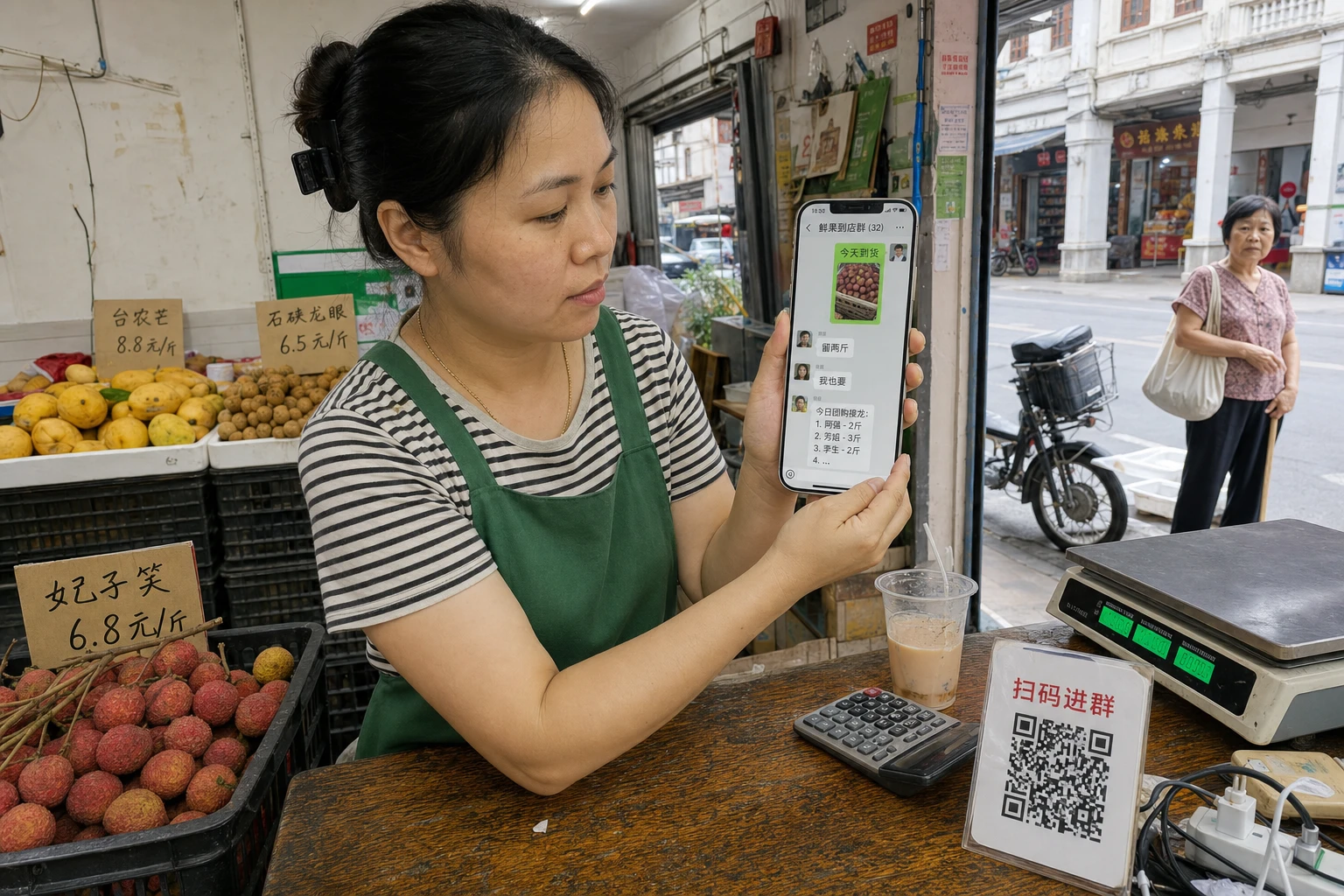
Private domain traffic means customers you can reach again without paying a platform for each view. In China that mostly means WeChat (微信): followers of your Official Account, customers added as contacts in WeCom (企业微信), and the customer groups those contacts sit in.
Public traffic is the opposite. You buy reach on Douyin (抖音) or Xiaohongshu (小红书), and it stops when the budget stops.
WeCom is the tool built to hold those contacts.
WeCom connects more than 14 million companies and organizations, and companies serve more than 750 million WeChat users a day through it. Source: Xinhua (新华网), WeCom 5.0 launch, August 2025. http://www.news.cn/tech/20250820/fbe9a69fd7a742629cf8275238bb7b91/c.html
The market is large, but it’s no longer growing fast.
China’s private domain e-commerce market reached about 2.3 trillion yuan in 2024, and growth slowed to 6.3%. Source: iResearch (艾瑞咨询), 2025 China private domain e-commerce white paper, co-initiated with the social commerce platform Mengxiang, September 2025. https://pdf.dfcfw.com/pdf/H3_AP202509191746825230_1.pdf?1758361538000.pdf
Private domain is ordinary retail in China now. Your customers have joined plenty of brand groups before yours.
The three assets: Official Account, WeCom and groups
China’s retail trade body and Tencent’s retail team sort private domain into three strengths of tie.
Private domain splits into weak connections (WeChat Official Accounts, Channels), medium connections (groups) and strong connections (one-to-one WeCom shopping advisers). Source: China Chain Store & Franchise Association (中国连锁经营协会) and Tencent Smart Retail, private domain handbook, November 2021. http://www.ccfa.org.cn/portal/cn/xiangxi.jsp?id=443075&type=1&sharetype=1
The handbook dates from 2021. The split still matches how the tools work today, and the same handbook calls the one-to-one tie the most expensive to run.
The Official Account is your publishing channel. A foreign brand gets a service account, and that caps how often you can alert followers.
A WeChat service account can switch on the follower push notification four times per calendar month. Source: Tencent customer service (腾讯客服), confirmed October 2026. https://kf.qq.com/faq/120911VrYVrA131025QniAfu.html
WeCom (企业微信) contacts are the strong tie. A store employee or online adviser adds a customer, and the contact belongs to the company rather than to whoever holds the phone, which matters the day that person quits. There’s a ceiling per employee.
One WeCom member can hold up to 20,000 external contacts and customers combined, with no expansion. Source: WeCom help center (企业微信), October 2026. https://open.work.weixin.qq.com/help2/pc/20172
Groups sit in between. Cheaper than one-to-one chat. Less personal, too.
A customer group created by a WeCom user holds up to 500 people. A group created by a WeChat user holds up to 200. Source: WeCom help center (企业微信), October 2026. https://open.work.weixin.qq.com/help2/pc/17545
What it costs to build and to run
Platform fees are small. People cost the money.
| Cost line | Who charges it | What it costs |
|---|---|---|
| Official Account verification | Tencent | 99 dollars per application, overseas entity |
| WeCom verification | Tencent | Overseas: no fee on the help page; 1 to 3 days |
| WeCom contact capacity | Tencent | 2,000 contacts free, then a yearly tier |
| Tool licenses and data software | Tencent and vendors | Per account per year, plus subscriptions |
| Writing, replies and offers | Your team or agency | The largest line by far |
Overseas entities pay 99 US dollars per Official Account verification application, whether or not verification succeeds. Source: Tencent customer service (腾讯客服), confirmed October 2026. https://kf.qq.com/faq/190723aQvMR31907233IF7FV.html
A WeCom account registered as an overseas company verifies in 1 to 3 working days, and some functions are not supported, including external payment collection and conversation archiving. Source: WeCom help center (企业微信), June 2026. https://open.work.weixin.qq.com/help2/pc/16535
Each company gets 2,000 external contacts free, and capacity beyond that is bought in tiers valid for one year. An unverified company can add only 100 customers. Source: WeCom help center (企业微信), confirmed October 2026. https://open.work.weixin.qq.com/help2/pc/21326
Tools that plug into WeCom carry a license fee per account.
WeCom interface licenses cost 5 yuan a year for a basic account and 50 yuan for a customer-contact account at the smallest tier, priced since May 16, 2022. Source: WeCom (企业微信), notice to service providers, May 2022. https://open.work.weixin.qq.com/wwopen/common/readDocument/38829
A customer data tool on top of WeCom costs more. One listed vendor discloses what its average paying merchant spent.
Weimob’s subscription revenue per paying merchant was 15,367 yuan in 2025, across 58,396 paying merchants. Source: Weimob (微盟), 2025 annual results, March 2026. https://www1.hkexnews.hk/listedco/listconews/sehk/2026/0317/2026031700850.pdf
That’s an average across all Weimob subscriptions, not a quote for your setup.
Staff decide the budget. Someone writes the daily group message and answers questions in Chinese, every day, weekends included. Someone else plans the offers. Our in-house versus agency cost comparison prices a Shanghai team. Our pricing page lists private domain work, from WeCom setup to running customer groups, as a custom quote.
Group retention: why nobody can tell you what normal is
We looked for a dated, public benchmark for WeChat (微信) group retention. There isn’t one.
Figures like “most groups die within 90 days” circulate widely. We traced them to software vendors’ blogs, not to a dated survey with a method.
You can measure your own curve, though. WeCom (企业微信) reports group data in its admin console and through its interface.
WeCom’s group statistics report new groups, total groups, groups with at least one message, new members, total members, members who posted and total messages. WeCom keeps the data for 180 days. Source: WeCom developer center (企业微信), group chat statistics, December 2023. https://developer.work.weixin.qq.com/document/path/92133
| WeCom metric | What it tells you |
|---|---|
| Total members, day by day | Net growth; a fall means leavers outpaced new joiners |
| New members | How well your join path works |
| Groups with at least one message | How many groups are alive at all |
| Members who posted | The share of people who talk, not just read |
| Total messages | Volume, which can hide one noisy member |
Notice what’s missing: a “left the group” count. There isn’t one. To see people leaving, compare today’s total with yesterday’s total plus new members. The difference is your leavers.
Export the data every month. After 180 days it’s gone.
Read the curve against your join path. A spike of leavers right after a giveaway tells you who the giveaway attracted. What should worry you more is a message count falling faster than membership. That’s a group that has gone quiet but not yet emptied.
MINISO’s figure covers members, not groups. It still shows the gap between a large base and the people who actually buy.
About 55.0% of MINISO’s mainland members bought in the past 12 months, and members contributed 77.4% of its mainland GMV. Source: MINISO (名创优品), 2026 interim report, September 2026. https://www1.hkexnews.hk/listedco/listconews/sehk/2026/0924/2026092400866.pdf
Repeat purchase lift: what companies disclose
We don’t publish our clients’ program data, so this section uses what listed companies tell investors, in their own words.
| Company | Sector | What it disclosed | Period |
|---|---|---|---|
| Luckin Coffee | Coffee | Monthly purchase frequency up 30% after joining a group | 2021 |
| Semir | Kids’ wear | Repurchase rate up 15% at Puma Kids | 2025 |
| Pagoda | Fruit | About 32,000 store groups; 115.6 million yuan in group sales | 2025 |
| Topsports | Sportswear | Members’ share of sales slipped from 93.7% to 91.7% | 2024-26 |
At Luckin Coffee, users’ monthly purchase frequency rose 30% after joining a group, and weekly repurchasers rose 28%. Luckin had 30,000-plus groups with 4.5 million members. Source: China Chain Store & Franchise Association (中国连锁经营协会) and Tencent Smart Retail, private domain handbook, November 2021. https://file.tencentads.com/files/pdf/2022/3/27d9c6f7046347a9b5a05a217244e5cd.pdf
Read that one with care. The figures date from 2021, and people who join a coffee brand’s group already buy coffee there often. A before-and-after lift is not a controlled test.
Semir’s Puma Kids business lifted its repurchase rate 15% through its member system and group operations. Source: Semir Apparel (森马服饰), 2025 annual report, March 2026. https://static.cninfo.com.cn/finalpage/2026-03-31/1225053655.PDF
Puma Kids is the closest case to yours: a foreign brand’s line, run in China by a Chinese group, using members and groups.
Pagoda ran about 32,000 store WeChat groups with 16.9 million followers in 2025. Sales through its group ordering tool topped 115.6 million yuan, while revenue fell to 8,174.4 million yuan from 10,273.3 million. Source: Pagoda (百果园), 2025 annual report, April 2026. https://www1.hkexnews.hk/listedco/listconews/sehk/2026/0430/2026043001076.pdf
By our arithmetic, group-tool sales came to about 1.4% of Pagoda’s revenue. That’s a small line for thirty-two thousand groups. In fairness, Pagoda also uses the groups to send people into its stores, and that figure doesn’t capture those visits.
Members’ share of Topsports’ offline store and WeChat Mini Program sales went from 93.7% to 93.2%, 92.9% and 91.7% across four reporting periods, from August 2024 to February 2026. Source: Topsports (滔搏), annual report 2025/26, June 2026. https://www1.hkexnews.hk/listedco/listconews/sehk/2026/0624/2026062400677.pdf
Still above nine in ten, but drifting down.
How often a group will put up with you
WeCom (企业微信) sets the outer limit. It’s generous.
By default, each customer or customer group can receive as many mass messages a month as the month has days. Administrators can change this to seven a week or one a day. Messages sent by staff and by the company share the same quota. Source: WeCom developer center and help center (企业微信), November 2025 and May 2026. https://developer.work.weixin.qq.com/document/path/92135 and https://open.work.weixin.qq.com/help2/pc/14738
A customer sees at most three Moments posts a day from the same person. Source: WeCom help center (企业微信), December 2025. https://open.work.weixin.qq.com/help2/pc/14767
Chinese law cares about something else: consent.
Nobody may send ads electronically without the recipient’s consent or request. The sender must state its identity and offer a way to refuse further messages. Source: Advertising Law of the PRC (广告法), Article 43, as amended April 2021, published by SAMR (国家市场监督管理总局). https://www.samr.gov.cn/zw/zfxxgk/fdzdgknr/fgs/art/2023/art_5474cf75173c45d6a0379730fb4e8d97.html
In our view, the quota is a ceiling, not a plan. A group of regular buyers will take one useful message on most days: a restock, a recipe, a member price. It won’t take three promotions before lunch. Invite people rather than adding them. The welcome message should say who you are and what the group is for, then tell people how to leave.
Where private domain fails: three patterns
If your numbers look thin so far, one of these is usually the reason.
The broadcast channel is the most common. A brand pushes one promotion to every group, people mute it or leave, and a few complain, which is the part WeCom (企业微信) punishes.
Harassing external contacts, causing complaints or adding contacts maliciously breaks WeCom rules. A first violation brings a short ban on messaging WeChat users, and a third brings a permanent one. Source: WeCom help center (企业微信), violation rules dated March 2024. https://open.work.weixin.qq.com/help2/pc/14664
Then there’s the discount club. A group built on coupons teaches people to wait for coupons, and many leave when the coupons stop. Pagoda’s filing shows the strain on paid membership.
Pagoda’s membership income fell to about 36.0 million yuan in 2025 from 76.6 million, and it said members’ willingness to pay for membership had weakened. Source: Pagoda (百果园), 2025 annual report, April 2026. https://www1.hkexnews.hk/listedco/listconews/sehk/2026/0430/2026043001076.pdf
The last pattern ends in a fine. Groups feel private, so claims slip in that would never pass on a public account (a supplement that “cures,” a food that “treats”). Regulators read them anyway.
A store that ran 18 WeChat member groups to spread false health claims for ordinary food was fined 200,000 yuan. Source: SAMR (国家市场监督管理总局), typical cases of false online food advertising, September 2026. https://www.samr.gov.cn/xw/zj/art/2026/art_7c21a79272864a4382acc083e410ff3d.html
Customer contacts are personal information under Chinese law, too.
Personal information violations can bring fines of up to 50 million yuan or 5% of the previous year’s turnover in serious cases. Source: Personal Information Protection Law (个人信息保护法), Article 66, in force November 2021, NPC (中国人大网). http://www.npc.gov.cn/npc/c2/c30834/202108/t20210820_313088.html
How to start with one hundred customers
One hundred is also where an unverified WeCom (企业微信) account hits its customer cap, which you saw in the cost section.
So verify first. Then pick your best one hundred customers, the people who already bought twice, and invite them to one group with a clear purpose.
Use a join-group QR code, not a plain group code, so the code on your packaging keeps working as groups fill.
A WeCom join-group code can link up to five customer groups and, by default, creates a new group automatically when one is full. Source: WeCom developer center (企业微信), January 2026. https://developer.work.weixin.qq.com/document/path/92229
Switch on the group anti-harassment rules on day one. WeCom can then remove or warn a member who posts links, mini programs or QR codes.
Give the group one thing nobody else gets. First access to a restock is enough. Then watch the five metrics above every week for three months. If the message count holds and repeat orders from members beat your non-members, add the next hundred.
If you already run groups and can’t see that line, audit them before adding more. Pull six months of group data, count your leavers and compare members’ repeat orders with everyone else’s. If members don’t reorder more after three months, more messages won’t fix it. The offer or the product needs work. Our WeCom explainer covers the tool itself, and our CRM and Private Domain Traffic service covers WeCom setup and running customer groups.
FAQ
What is private domain traffic in China?
Private domain traffic is the customers a brand can reach again without paying a platform for each view. In China it mostly lives inside WeChat (微信): Official Account followers, customers added as WeCom (企业微信) contacts, and the customer groups they join. Public traffic, such as Douyin (抖音) or Xiaohongshu (小红书) ads, stops when the budget stops. Private domain is built for repeat buying.
What retention should a WeCom group achieve?
We found no public, dated benchmark, so be wary of anyone quoting one. Measure your own: WeCom reports total members, new members and groups with messages, and keeps the data for 180 days. Leavers equal yesterday’s total plus new members minus today’s total. A message count falling faster than membership is the early sign of a dead group.
How much does a private domain program cost?
Platform fees are small. An overseas entity pays 99 dollars per Official Account verification, and WeCom includes 2,000 contacts free before yearly capacity fees. Data tools cost more; one listed vendor’s subscription revenue averaged 15,367 yuan per paying merchant in 2025. The largest cost is the people who write to the group and answer customers every day.
Want to grow your brand on China's social platforms?
Book a call