Platforms
WeChat vs Xiaohongshu: which one to launch on first
Launch on Xiaohongshu (小红书) first if Chinese buyers don't know you yet and research before they buy. Launch on WeChat (微信) first if your sale needs a conversation, a repeat order, or a sales rep.
WeChat vs Xiaohongshu has no single answer, because WeChat (微信) and Xiaohongshu (小红书) do different jobs. The useful question is which job your brand needs done first.
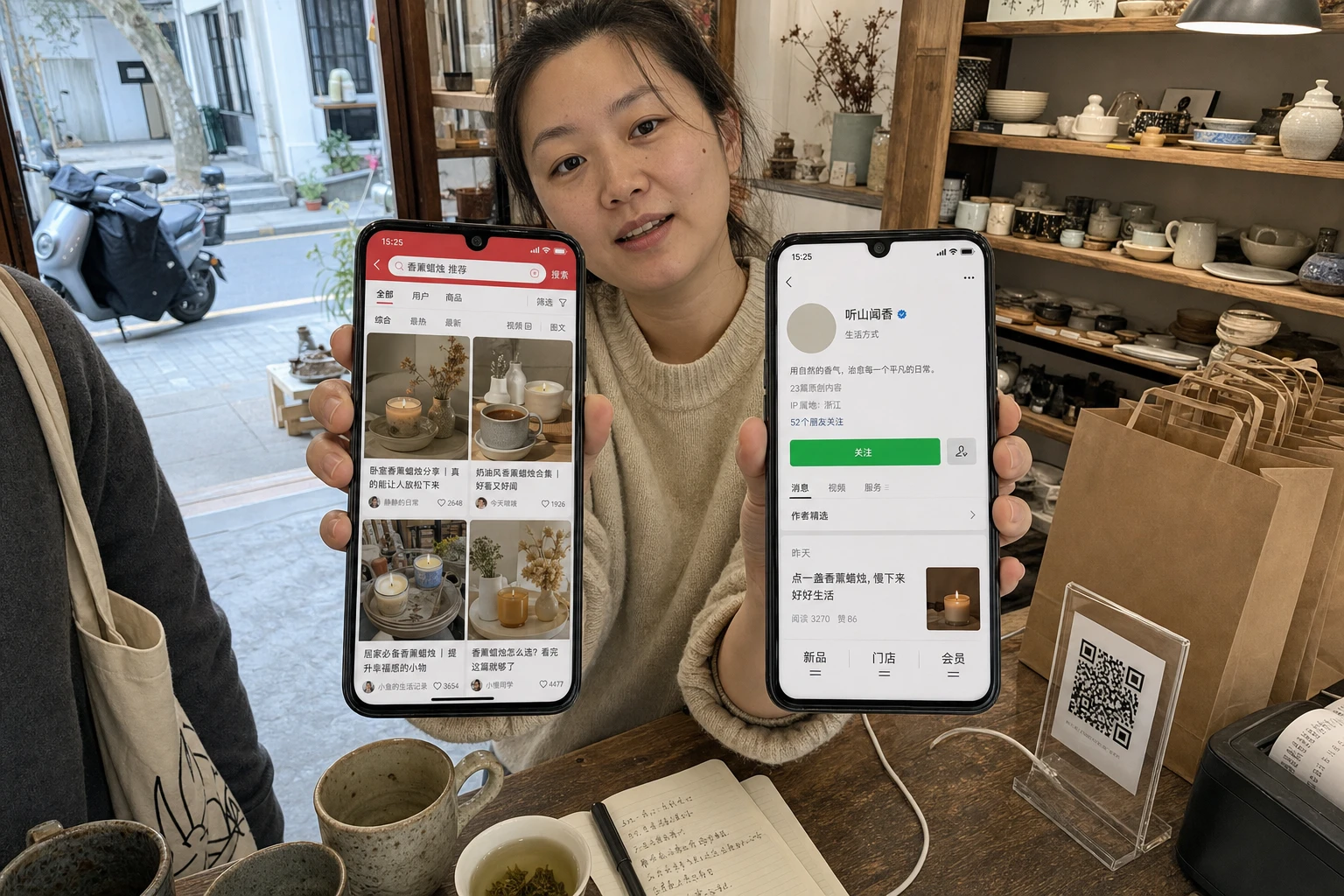
WeChat is where Chinese buyers stay in touch with brands they already know. Xiaohongshu, also called RedNote, is where they find brands they don’t. Here they are on the five points that decide a launch, each sourced below.
| Point | Xiaohongshu | |
|---|---|---|
| Audience | 1.4 billion monthly accounts | 400 million monthly users, younger and urban |
| Intent | Chat and repeat purchases | Search and compare before buying |
| Content | Long articles pushed to followers | Photo and video notes ranked by search and feed |
| Platform cost to open | 99 US dollars a year to verify (overseas) | 600 yuan a year to verify |
| Speed to first reach | Slower: a push reaches only followers | Faster: fresh notes get a big share of the feed |
Most brands end up on both. Which one gets the budget first depends on how you sell: at a checkout, or through a salesperson. The decision table at the end adds product type and price point.
WeChat vs Xiaohongshu: two platforms, two different jobs
First, size.
WeChat and its international version had 1.418 billion combined monthly active accounts at the end of 2025, up 2% from a year earlier. Source: Tencent Holdings 2025 results, reported by Tencent News (腾讯新闻), March 2026. https://news.qq.com/rain/a/20260318A07APT00
Xiaohongshu’s monthly active users passed 400 million, with 800 million searches a day. Source: Xiaohongshu (小红书) Video Creator Trend Observation Report, reported by Beijing Business Today (北京商报), May 2026. https://finance.sina.com.cn/jjxw/2026-05-27/doc-inhziqxq9291575.shtml
WeChat (微信) is more than three times larger, but size measures reach. Whether anyone finds you depends on why people open the app.
WeChat is a messaging app first. People open it to message friends, pay for things, and now and then read the accounts they follow. Xiaohongshu (小红书) is a search and review app. People open it to work out what to buy, and whether it’s worth the money.
A shopper asks Xiaohongshu who to buy from. Once they’ve bought, WeChat is where they hear from you again.
WeChat is retention. Xiaohongshu is discovery.
On Xiaohongshu (小红书), most people arrive looking for something.
77% of Xiaohongshu’s daily active users use search to solve a problem, and 75% browse the recommendation feed. Source: Huxiu (虎嗅), May 2026. https://www.huxiu.com/article/4861801.html
About 200 million users a month come to Xiaohongshu for purchase advice, and the average user opens the app 16 times a day. Source: Xiaohongshu (小红书) WILL 2026 conference, reported by Economic Observer (经济观察网), December 2025. http://m.eeo.com.cn/2025/1223/774754.shtml
The feed also favors new posts. That’s why a brand with no followers can still reach strangers there.
Notes published within the past day made up close to half of home feed exposure, according to Xiaohongshu’s own distribution engineers. Source: Xiaohongshu technology team, published on AIQ, March 2023. https://www.6aiq.com/article/1679451572481
That’s a 2023 figure, the latest the engineers have published.
WeChat (微信) works the other way round. An Official Account (公众号) pushes articles to people who already follow it. A foreign company gets one account, of one type, and only four push alerts a month.
An overseas entity can register one account, and overseas regions support the service account type only. The account can be used only after verification. Source: Tencent customer service (腾讯客服), overseas service account registration, confirmed October 2026. https://kf.qq.com/faq/180312zQjeYV180312FNNbmA.html
A service account can send the follower push notification 4 times per calendar month. An Official Account, the former subscription account, can send it once a day. Source: Tencent customer service (腾讯客服), mass messaging rules, confirmed October 2026. https://kf.qq.com/faq/120911VrYVrA131025QniAfu.html
Four pushes a month, to followers you don’t have yet. They have to come from somewhere else: ads, a QR code in a store, an article shared in a chat, or search.
In 2022, WeChat Search had 800 million monthly active users and brought in 27% of new Official Account followers. Source: WeChat Open Class PRO 2023 (微信公开课PRO), reported by 199IT on Sina Tech (新浪科技), January 2023. https://finance.sina.com.cn/tech/roll/2023-01-10/doc-imxztfeh2280083.shtml
Tencent hasn’t published a newer split. But search needs people to know your name well enough to type it.
Keeping a customer is where WeChat is strongest. Chat, payment, a store inside the app (a Mini Program, 小程序), and one-to-one follow-up all sit in one place.
Mini Program user time grew more than 20% year on year in the fourth quarter of 2025. Source: Tencent Holdings 2025 results, reported by China Fund News (中国基金报), March 2026. https://www.chnfund.com/article/AR1231fcdd-25ff-01cd-2836-3a2015e46b1d
| Job | Xiaohongshu | |
|---|---|---|
| Get found by strangers | Weak without ads or a known name | Strong: search and the feed |
| Earn trust before a sale | Articles for people who follow you | Notes and reviews from other users |
| Close the sale | Mini Program and WeChat Pay | In-app store, live cart, and lead form |
| Keep the customer | Strong: chat, pushes, and WeCom | Limited: no contact details in posts |
Launch on Xiaohongshu first if these five things are true
The next two lists are a quick test. Count how many lines describe your business.
1. Buyers research before they buy. Skincare, fashion, food, travel, home goods, and baby products all fit. In these categories shoppers tend to read other people’s notes before they spend, and Xiaohongshu (小红书) is built around those notes.
2. Your buyer is young, urban, and more likely to be a woman. The platform’s own advertiser brief describes that user.
Xiaohongshu’s official advertiser brief puts its male to female split at 3 to 7. Half its users were born in 1995 or later, and half live in first- and second-tier cities. Source: Xiaohongshu (小红书) official brief, reported by Qian-gua Data (千瓜数据), April 2025. https://www.qian-gua.com/information/detail/3149
3. Nobody in China knows your name yet. WeChat (微信) search can’t find a brand nobody is looking for. On Xiaohongshu, people search for the need, such as a sunscreen for oily skin, and find brands they never typed.
4. The buyer decides alone. People save notes, compare, and then buy, without a call with anyone at your company.
5. You want to test cheaply. Small paid tests can run in week one.
The self-serve boost tool (薯条) has no follower threshold and a minimum spend of 75 yuan per order. Only content published in the last 90 days can be boosted. Source: Woshipm (人人都是产品经理), May 2026. https://www.woshipm.com/share/6397056.html
If three or more of these fit, Xiaohongshu should take the lead. Our RedNote platform page covers what we run there.
Launch on WeChat first if these five things are true
1. Your sale needs a conversation. Cars, property, education, hotels, insurance, and equipment all involve questions before a signature. WeChat (微信) is where that chat happens.
2. You already have Chinese customers. Distributors, hotel guests, alumni, and past buyers will follow an account they recognize. They can find it by name, because they already know it.
3. People buy from you again and again. Refills, memberships, and bookings need a channel that holds the relationship. Pushes, a Mini Program (小程序), and one-to-one chat do that.
4. You have foot traffic. A store or a trade fair stand will do. Put a QR code there and each scan turns a visitor into a follower (a code printed on a shopping bag counts).
5. You want your own store inside the app. A Mini Program with WeChat Pay (微信支付) lets people buy without leaving WeChat.
Three or more of those, and WeChat leads. Our WeChat platform page shows the setup we run.
The B2B answer is different: WeChat, with WeCom behind it
In the West, a B2B launch usually starts on LinkedIn. In China, LinkedIn no longer offers a local network to start on.
LinkedIn, which had closed its social networking features in China two years earlier, announced in May 2023 that its China job app (领英职场) would stop service on August 9, 2023. Source: China National Radio (央广网), May 2023. https://tech.cnr.cn/ycbd/20230509/t20230509_526245629.shtml
That leaves WeChat (微信) as the working channel for most B2B sellers. The Official Account (公众号) carries case studies and technical articles. WeCom (企业微信), the business version of WeChat, carries the sales team’s one-to-one chats with buyers.
Each company gets 2,000 WeCom external contacts free. Beyond that it buys a capacity tier, valid for one year. An unverified company can add only 100 customers. Source: WeCom help center (企业微信帮助中心), external contact capacity, confirmed October 2026. https://open.work.weixin.qq.com/help2/pc/21326
Xiaohongshu (小红书) still has a B2B role, but a narrow one. It works when the buyer is one person spending their own money or a small firm’s, and doing the research alone: an interior designer choosing a supplier, a clinic owner pricing equipment, a studio founder looking for software, a shop owner hunting for stock. The platform’s lead tools, including the employee accounts it calls KOS, suit that buyer.
More than 40,000 companies run KOS (employee) accounts on Xiaohongshu, with over 400,000 employee accounts producing more than 6 million leads a month, according to platform data for August 2026. Source: Xiaohongshu (小红书) 2026 KOS guide, reported by Huaxia Morning News (华夏早报) on ifeng (凤凰网), September 2026. https://baby.ifeng.com/c/8wUkh912dXd
Xiaohongshu doesn’t publish how many of those leads are B2B.
For a factory selling to factories, WeChat comes first, and Xiaohongshu can wait.
What it costs to run one platform versus both
Then there’s the money. Short answer: a second platform adds one more small fee and a second content stream. Most of the money goes on people and content, not on the platforms. The fees below are as Tencent and Xiaohongshu (小红书) published them when we checked on October 5, 2026.
An overseas entity pays 99 US dollars per verification application, charged whether or not the review succeeds. Review takes 7 to 15 working days after complete documents are submitted. Source: Tencent customer service (腾讯客服), overseas entity verification FAQ, confirmed October 2026. https://kf.qq.com/faq/190723aQvMR31907233IF7FV.html
Xiaohongshu enterprise accounts accept companies from mainland China, from outside China, and from Hong Kong, Macau, and Taiwan. Verification costs 600 yuan per application and is valid for one year, with an annual review. Overseas companies apply on the desktop site. Source: Xiaohongshu (小红书) enterprise account verification guide, platform document, confirmed October 2026. https://fe-video-qc.xhscdn.com/picasso-editor/7072d509ee7370545a056b6f9030a926e8879dca.pdf
Xiaohongshu’s current verification rules support overseas companies by the regions and industries the platform has opened. They name mainland China, Hong Kong, Singapore, and Malaysia. Source: Xiaohongshu Juguang help center (小红书聚光帮助中心), enterprise professional account verification rules, updated October 2026. https://ad.xiaohongshu.com/next_help/docs/195c5fe505c71b4b0335a2fe0d61d8e0
Moments ads bought by bidding start at a 1,000-yuan daily budget, but bidding is open only outside Tencent’s core and key cities. Scheduled buys, open in all cities, start at 50,000 yuan per placement. Source: Tencent Ads (腾讯广告), WeChat advertising product page, confirmed October 2026. https://e.qq.com/topic/marketing/industry/weixin/
| Cost line | Xiaohongshu | |
|---|---|---|
| Verification | 99 US dollars a year (overseas company) | 600 yuan a year |
| Organic posting | Free, 4 pushes a month for a service account | Free |
| Smallest paid test | Moments bidding from 1,000 yuan a day | Boost tool from 75 yuan an order |
| Content format | One long article a week | Several short notes a week |
| Who you pay most | Writers and a WeCom team | Content makers and creators |
Running both barely moves the platform fees. It does double the content work, because one format doesn’t carry across. A WeChat (微信) article is long and written for followers. A Xiaohongshu note is short, personal, and written for a stranger with a search query.
Our WeChat marketing cost breakdown and our Xiaohongshu marketing cost guide list every line in detail.
Agency fees are the line you’ll struggle to compare, because so few agencies publish them.
0 out of 37 agencies analyzed offer fixed-price packages. Source: TheRedScroll competitive analysis, April 2026.
Our own packages cover both platforms, plus Douyin and Weibo. The prices are on our pricing page, not in this article. Ad spend is paid to the platforms directly, with no markup.
The launch order most brands should use
Going first on one platform doesn’t mean ignoring the other. In practice, the lead platform gets most of the content and the paid budget in the first months.
Month one: open both accounts. Verification is cheap, and the overseas WeChat (微信) review alone can take three weeks. It costs little now and saves a wait later.
Months one to three: put the weight on the lead platform. The bulk of the content, and every paid test, goes there. The other account runs at a minimum: one WeChat article a week, or a few Xiaohongshu (小红书) notes.
Moving people from one platform to the other takes care, because Xiaohongshu doesn’t let you send them to WeChat.
Since March 12, 2025, Xiaohongshu’s trade-diversion rules ban spreading personal or group contact details and other platforms’ account or store information. Purchases should go through the Xiaohongshu store, the live cart, or the official lead-capture form. Source: Sanyi Shenghuo (三易生活), March 2025. https://www.3elife.net/Art/internet/202503/12/101166.html
So the bridge is your Chinese brand name. Use the same one on both accounts. A reader who trusts you on Xiaohongshu can then find you by searching WeChat. Packaging and receipts can carry the WeChat QR code. So can the stand at a trade fair.
Months four to six: shift the weight. Once people search for your name, there’s demand for the WeChat account to pick up. Add WeCom (企业微信) so staff can follow up one to one.
Our first 90 days guide gives the week-by-week schedule for the start.
A decision table: product type by price point
Find your product type, then your price point. The cell names the lead platform, WeChat (微信) or Xiaohongshu (小红书). “Both” means open both and split the effort evenly. The sales model can override it: if a salesperson closes the deal, WeChat leads wherever the cell says “Both.”
| Product type | Everyday price | Considered buy | High ticket |
|---|---|---|---|
| Beauty, skincare, fashion | Xiaohongshu | Xiaohongshu | Xiaohongshu, then WeChat |
| Food and drink | Xiaohongshu | Xiaohongshu | WeChat for gifting and repeat |
| Travel, hotels, restaurants | Xiaohongshu | Xiaohongshu | Both, WeChat for bookings |
| Consumer tech, home goods | Xiaohongshu | Xiaohongshu | Both |
| Education, health services | Xiaohongshu | Both | |
| Luxury goods | Xiaohongshu | Both | WeChat, Xiaohongshu for research |
| Cars and property | Does not apply | Both | |
| B2B: industrial, software, services |
These cells are our rule of thumb, built from the platform facts above. They are not a platform statistic.
FAQ
Should a new brand start on WeChat or Xiaohongshu?
A consumer brand that nobody in China knows yet should usually lead on Xiaohongshu (小红书), where 77% of daily users search to solve a problem. A brand whose sale needs a conversation, or which already has Chinese customers, should lead on WeChat (微信). Open both accounts in month one either way. The overseas WeChat review alone can take 15 working days.
Can you run both platforms on a small budget?
Yes, if one platform leads and the other runs at a minimum. The fees are small: 99 US dollars a year to verify an overseas WeChat account and 600 yuan for Xiaohongshu. The cost is content, because a WeChat article and a Xiaohongshu note are different formats. Budget for two content streams, not one.
Which platform is better for B2B in China?
WeChat (微信), for most B2B sellers. LinkedIn’s China job app closed in August 2023. That leaves the Official Account (公众号) for case studies and WeCom (企业微信) for the sales team’s chats. Xiaohongshu (小红书) helps when the buyer is a single person or a small firm, such as a designer or clinic owner, and its employee accounts produce more than 6 million leads a month.
Not sure which way your product points? Tell us what you sell and who closes the sale, and we’ll say which platform to open first.
Want to grow your brand on China's social platforms?
Book a call